Batteries
What Size Battery Bank for 300 Amp-Hours a Day? (LiFePO4)
Researched from published standards and manufacturer specifications. Updated .
Quick answer
This page answers one question: if your RV uses 300 amp-hours a day, how much LiFePO4 battery do you need to buy? The arithmetic is short. Multiply daily use by the number of days you want to go without charging, then divide by the fraction of the battery you are willing to use.
That last fraction is the part people get wrong. A 300Ah daily load does not need a 300Ah battery. Run the numbers for your own use with the battery bank calculator, and if you have not measured your daily draw yet, build it up load by load with the daily energy budget calculator.
How many amp-hours of LiFePO4 battery for 300Ah a day?
Nameplate capacity is what the label says. Usable capacity is what you get before you are into the part of the discharge curve that shortens the battery's life. These are the sizes for 300Ah a day at 80 percent depth of discharge.
| Days off grid | Energy needed | Nameplate capacity | Stored energy at 12V |
|---|---|---|---|
| 1 day | 300 Ah | 375 Ah | 3,600 Wh usable |
| 2 days | 600 Ah | 750 Ah | 7,200 Wh usable |
| 3 days | 900 Ah | 1,125 Ah | 10,800 Wh usable |
| 4 days | 1,200 Ah | 1,500 Ah | 14,400 Wh usable |
Convention Source: Common planning figure. Individual LiFePO4 manufacturers publish their own usable depth and cycle life.. Depth of discharge is a planning convention rather than a published specification. Battery manufacturers publish cycle life against depth of discharge curves instead of a single usable percentage.
What does that look like in real batteries?
A 750Ah bank for two days off grid is 8 batteries of 100Ah, or 4 of 200Ah. At roughly 25 pounds per 100Ah LiFePO4 battery, that is about 188 pounds.
Batteries wired in parallel add capacity at the same voltage. Keep the interconnect cables identical in length and gauge, or the nearest battery does more of the work and ages faster than the rest.
Would lead-acid be a better choice at this load?
For the same 300Ah daily load over two days, lead-acid needs about 1,200Ah of nameplate capacity against 750Ah for LiFePO4. Lead-acid is cheaper per nameplate amp-hour and considerably heavier per usable amp-hour, and it will not accept a fast charge the way lithium does. See LiFePO4 vs AGM for RV house batteries and the usable capacity calculator.

VMAX SLR100 12V 100Ah AGM Deep Cycle
$269.96A true deep cycle AGM with no cranking rating on the label, which is the fastest way to tell a house battery from a starting battery.
Best for: A lead-acid bank where lithium is out of budget.
Check price on Amazon
UPLUS 12V 100Ah Deep Cycle AGM, Group 27
$189.99Sold as a leisure battery rather than a dual purpose one, so it is built for repeated discharge rather than engine starting.
Best for: The cheapest honest deep cycle option.
Check price on AmazonHow much charging does a bank this size need?
Replacing 300Ah a day means putting back about 3,600 watt-hours. At a 0.75 system derate, that needs roughly 1,200W of solar at four peak sun hours, or about 873W at five and a half. Size it against your own region with the solar array calculator.
Charging from the tow vehicle is the other option. A DC-DC charger is what makes that safe on a lithium bank, and the DC-DC charger calculator sizes one against your alternator.
LiFePO4 batteries that suit a 300Ah daily load

Super Empower 12V 100Ah LiFePO4, Group 24
$182.99A Group 24 case drops into most existing lead-acid battery boxes without modification, and the BMS stops charging below freezing.
Best for: A first lithium conversion in a travel trailer that already has a Group 24 tray.
Check price on Amazon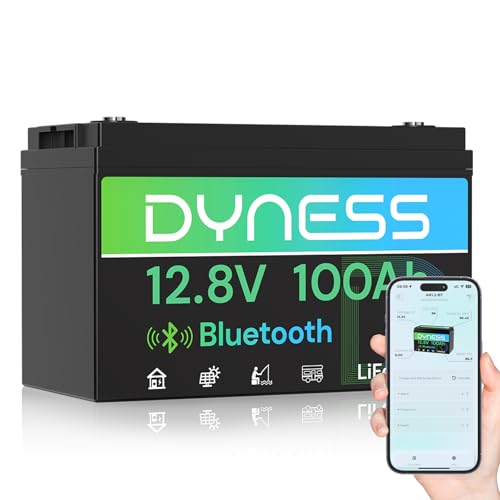
Dyness 12V 100Ah LiFePO4 with Bluetooth
$199.98Bluetooth reporting of pack voltage and state of charge means you can check the bank without adding a separate shunt monitor.
Best for: Owners who want pack data without wiring a shunt on day one.
Check price on Amazon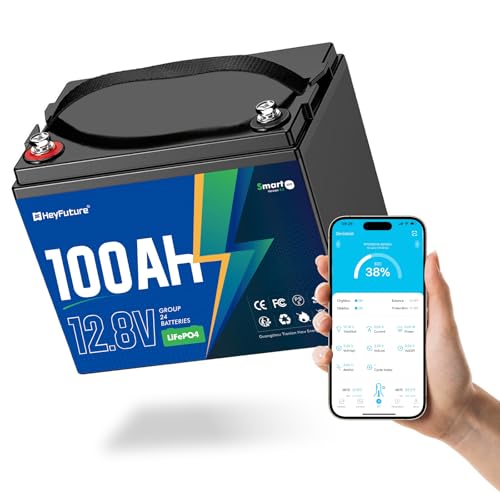
HeyFuture 12V 100Ah LiFePO4 with Bluetooth
$159.99One of the lower-cost Bluetooth packs with a published 100A BMS rating, which is the figure that limits inverter size.
Best for: A single-battery bank feeding a 1000W inverter.
Check price on Amazon
Vemdia 12V 100Ah LiFePO4, Group 31
$153.99A Group 31 case with a 100A BMS, which is the common size for a purpose-built RV battery compartment.
Best for: Replacing a single Group 31 lead-acid battery.
Check price on AmazonFrequently asked questions
- How many batteries do I need for 300 amp-hours a day?
- For two days off grid at 300 amp-hours a day you need about 750 amp-hours of LiFePO4 nameplate capacity, which is 8 batteries of 100Ah each. For a single day between charges you need about 375 amp-hours. The difference between nameplate and usable capacity is why the bank is always larger than the daily figure.
- Why can I not just buy a 300Ah battery for a 300Ah daily load?
- Because you do not get to use all of a battery's nameplate capacity. Planning LiFePO4 at 80 percent depth of discharge means a 300 amp-hour battery only delivers about 240 amp-hours before you should recharge it. Discharging deeper than that repeatedly shortens the battery's life, and on lead-acid it does so sharply.
- How much solar does a 300Ah per day load need?
- Replacing 300 amp-hours a day at 12 volts is about 3,600 watt-hours. At four peak sun hours and a 0.75 system derate that needs roughly 1,200 watts of panel. Peak sun hours vary a great deal by region and season, so check your own figure rather than assuming four.
- Does cold weather change the bank size I need?
- It changes what the bank can do rather than the arithmetic. Lead-acid loses usable capacity as temperature falls, so a cold bank delivers less than its rating. LiFePO4 holds capacity better but must not be charged below freezing, so a cold-weather lithium bank needs either a low temperature cutoff in the BMS or a self-heating battery. Furnace blower run time also rises in cold weather, which increases the daily load itself.
Lithium safety. A LiFePO4 bank needs a charger with a genuine lithium profile, and that means the converter, the solar controller and any DC-DC charger all have to be set correctly. A stock lead-acid converter will never bring a lithium pack to full. Charging a lithium battery below freezing damages the cells permanently, so the pack needs either a low temperature charge cutoff in its BMS or a self-heating design if you camp in the cold.