Skip to content
RVPowerCalc

Air conditioning calculator

RV Air Conditioner Startup Load Calculator

Quick answer

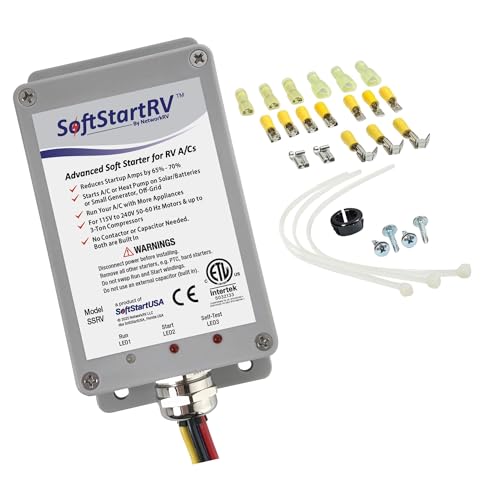
A 13,500 BTU RV air conditioner draws roughly 1,400W running and about 3,000W to start. A soft starter typically cuts that inrush by more than half, which is what lets a 2,000W generator start a unit it otherwise cannot.

Your numbers

Results update as you type. Nothing you enter leaves your browser.

Result

Startup surge 3000 W
Running load 1400 W
Supply available 2000 W
Will it start No, not on this supply

The formula

startup W = running W x locked rotor multiplier; with soft start, multiplier falls sharply

The multiplier is a convention drawn from typical compressor behavior. Your unit publishes a locked rotor amps figure on its data plate, and that is the authoritative number.

The figures shown above are computed with these exact inputs: Air conditioner size 13500, Soft starter fitted no, Supply available 2000 W.

Components that match this result

Every card below is in the page source. The calculator re-ranks them against your numbers and marks anything that falls short of what you just calculated.

Frequently asked questions

How does the air conditioner startup load calculation work?
startup W = running W x locked rotor multiplier; with soft start, multiplier falls sharply. The multiplier is a convention drawn from typical compressor behavior. Your unit publishes a locked rotor amps figure on its data plate, and that is the authoritative number.
Are these figures published standards or rules of thumb?
Both, and the page labels which is which. Conductor ampacity, resistance, voltage drop limits, overcurrent sizing factors and device ratings come from NEC, ABYC and NEMA and are labeled as published standards. Depth of discharge, solar derate factors and inverter efficiency are planning conventions with no standards body behind them, and are labeled as conventions.
Why does this calculator sometimes say there is no answer?
Because there genuinely is not one within the published tables. Rather than extrapolating past the end of an ampacity table or inventing a figure to fill a gap, the calculator returns nothing and explains why. A run that is too long for the current at 12 volts needs a shorter run or a higher system voltage, not a made up wire size.
Do I still need an RV technician if I use this?
For DC work many owners do their own installation, and these figures are the ones that work is sized from. Permanent AC wiring, anything connected to the shore power inlet and anything behind the distribution panel is work for a qualified RV technician or a licensed electrician. Sizing a circuit correctly and installing it safely are two different jobs.

Researched guidance, not professional advice. These results are planning figures from published standards and manufacturer specifications. Never exceed a conductor's rated ampacity, fuse every positive conductor close to the battery, never run a generator in an enclosed space because carbon monoxide is lethal and odorless, and have permanent AC wiring done by a qualified RV technician or licensed electrician.