Guides
RV Lithium Battery Conversion Guide: Lead-Acid to LiFePO4
Researched from published standards and manufacturer specifications. Updated .
Quick answer
Swapping a lead-acid battery for a LiFePO4 one is the easy half of a lithium conversion. The battery itself is a physical swap, often into the same tray. The hard half is charging: lead-acid and lithium want different voltages, different acceptance curves, and different protection at low temperatures, and every source that charges the battery has to agree on the same profile.
This guide walks the conversion in the order that actually matters: size the bank, check the converter, reset the solar controller, add alternator charging correctly, add a monitor that can actually read a lithium state of charge, and confirm the BMS before you connect an inverter. Skipping the charging steps is the most common way a lithium upgrade fails to deliver what it was supposed to.
What actually has to change when you switch to lithium?
The battery chemistry is the visible change, but three charging sources have to change with it. The converter needs a genuine lithium charge profile rather than the lead-acid profile it likely ships with. The solar charge controller needs to be set to LiFePO4 rather than defaulting to a lead-acid curve. And if you charge from the engine alternator while driving, that connection needs a DC-DC charger in between, because lithium accepts current far more readily than lead-acid and can pull more than an alternator was built to sustain. A stock lead-acid converter left in place will never bring a LiFePO4 bank to full charge, no matter how long it stays plugged in.
How much usable capacity do you actually gain?
LiFePO4 usable depth of discharge is a widely used planning convention, not a fixed specification. Many packs are rated to full depth of discharge; planning at a lower figure leaves reserve.
| Chemistry | Usable DoD (convention) | Usable amp-hours from 100Ah |
|---|---|---|
| Lead-acid | 50% | ~50Ah |
| LiFePO4 | 80% | ~80Ah |
Convention Source: Depth of discharge conventions documented in this site's power.mjs: 50 percent for lead-acid, 80 percent for LiFePO4. Individual manufacturers publish their own cycle life against depth of discharge.. Run the battery bank calculator with your own daily amp-hour draw to size a replacement bank rather than assuming a straight amp-hour swap.
Does my existing converter work with a lithium battery?
Check the converter model against its own specification sheet before assuming it works. Many older two-stage and three-stage converters are built entirely around lead-acid absorption and float voltages and have no lithium setting at all. A converter with no lithium mode will chronically undercharge a LiFePO4 bank, leaving it stuck well short of full every time you plug into shore power, even though the converter itself looks like it is functioning normally. If the converter has no lithium profile, plan to replace it as part of the conversion rather than treating the battery swap as complete without it.
What does the solar charge controller need to change?
Most MPPT and PWM controllers ship set to a lead-acid charge curve by default, and switching chemistry in the menu is not optional. A controller left on its lead-acid setting will apply the wrong absorption and float voltages to a lithium bank, either undercharging it over time or, on some older controllers with no lithium option at all, applying voltages that are simply wrong for the chemistry. Confirm your controller has a genuine, ideally user-adjustable, lithium profile before wiring it to the new bank. Size the array itself with the solar array calculator, since panel wattage needs do not change with chemistry, only the charge voltages do.
Why does alternator charging need a DC-DC charger now?
Lead-acid batteries have enough internal resistance to naturally throttle how fast they accept charge current, which is what has let many rigs charge straight off the alternator for years without a problem. Lithium has much lower internal resistance and will draw current up to whatever the source can supply, so a direct wire to the alternator lets the battery pull more current than the alternator was ever built to sustain. A DC-DC charger sits between the alternator and the battery specifically to cap that current at a safe amperage. Size it with the DC-DC charger calculator against your battery capacity and typical drive time.
Why do I need a shunt monitor after converting to lithium?
LiFePO4 holds a nearly flat voltage across most of its usable range, roughly 13.3 to 12.9 volts on a 12V pack between about 80 and 20 percent state of charge, so a simple voltage-based meter reads misleadingly close to full for most of the discharge curve and then drops fast near empty. A shunt-based monitor tracks amp-hours in and out instead of relying on voltage, which is the only way to get an accurate state of charge reading on a lithium bank. Add one as part of the conversion rather than trying to read the bank the way you read the old lead-acid one.

Victron SmartShunt 500A Battery Monitor
Price varies, check the listingA shunt counts amp-hours in and out, which is the only accurate way to read lithium state of charge. Voltage alone cannot do it on a flat discharge curve.
Best for: Any lithium bank you plan to boondock on.
Check price on AmazonHow do I check the BMS against my inverter?
Every LiFePO4 battery ships with a built-in battery management system rated for a specific continuous discharge current, published on the spec sheet. Before wiring an inverter to the new bank, work out the DC current the inverter pulls at full load with the inverter sizing calculator, then confirm the BMS continuous rating covers that draw, plus some margin for a startup surge. A BMS that is undersized for the inverter will fault and disconnect the battery under load, which looks like a battery failure but is really a mismatch caught after the fact instead of before.
What order should the conversion happen in?
Work out the daily amp-hour budget and size the new bank first, using the daily energy budget calculator and the battery bank calculator. Check the converter's charge profile next, since it is usually the first thing plugged in after a new battery. Confirm or reset the solar controller profile third. Add the DC-DC charger fourth if the rig charges from the alternator. Install the shunt monitor fifth, before putting the system into regular use, so you have a baseline reading from day one. Check the BMS against the inverter last, right before the inverter goes into service.
What does the physical battery swap actually involve?
Disconnect the negative terminal first, then the positive, which reduces the risk of an accidental short from a wrench bridging the positive terminal to a grounded metal surface while the negative is still connected. Remove the old lead-acid battery and confirm the new LiFePO4 pack fits the existing tray and hold-down bracket, since case dimensions on common Group 24 and Group 31 sizes are close enough that most swaps are a direct fit with no bracket modification. Set the new battery in place, reconnect positive first, then negative, and check that the battery monitor or a basic multimeter shows a reasonable resting voltage before closing up the battery bay. The physical swap itself is usually the fastest part of the whole conversion, faster than checking and resetting even one charge source.
Should I convert every battery in the bank at once?
Converting the entire bank at once is the safer and more common approach, because mixing an old lead-acid battery with a new LiFePO4 battery in the same parallel bank is not recommended. The two chemistries settle to different resting voltages and accept charge current differently, so wiring them together lets one chemistry's needs mismatch the other's charge profile, and the batteries can end up fighting for current rather than sharing the load evenly. If budget requires converting in stages, fully retire the lead-acid battery from a given bank before adding the first lithium battery to it, rather than running the two chemistries side by side even temporarily.
How do I confirm the conversion is actually working after installation?
Watch the shunt monitor over the first full charge and discharge cycle rather than checking it once and moving on. A correctly configured system should show the bank reaching close to 100 percent state of charge from the converter alone, then the solar controller alone, then the DC-DC charger alone if the rig has one, since each source needs to be verified independently rather than assumed to work because the others do. A source that never brings the bank to full, checked in isolation from the others, is the sign that its charge profile still needs attention.
Never charge LiFePO4 below freezing without protection. A standard LiFePO4 cell must not accept charge current below freezing unless the battery has a low-temperature BMS cutoff or self-heating cells. Confirm which protection your battery has before your first cold-weather charge.
What to buy for a lithium conversion
Start with the battery and a shunt monitor together, since the monitor is what tells you whether the rest of the conversion is actually working. Add the DC-DC charger only if you charge from the engine while driving; a rig that only charges from shore power and solar can skip it entirely.
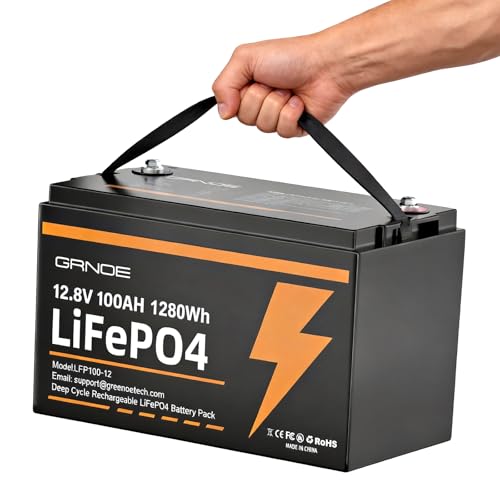
GRNOE 12V 100Ah LiFePO4, Group 31
$159.00Drops into a Group 31 tray built for a lead-acid battery, with a 100A BMS rating to compare against your inverter's draw.
Best for: Budget-led single battery replacement.
Check price on Amazon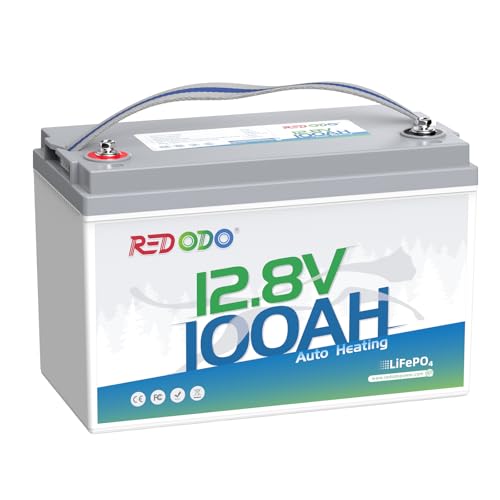
Redodo 12V 100Ah Self-Heating LiFePO4, Group 31
$278.99Self-heating cells pull warmth from the charge source before accepting current, which sidesteps the below-freezing charging limit covered later on this page.
Best for: Cold season camping where the battery bay drops below freezing.
Check price on Amazon Victron SmartShunt 500A Battery Monitor
Price varies, check the listingA shunt-based monitor that tracks amp-hours in and out, which is what a lithium bank needs since its voltage will not tell you state of charge.
Best for: Any lithium bank you plan to boondock on.
Check price on Amazon
Renogy 40A DC-DC Battery Charger
$186.99Multi-stage charging profiles for lithium, with a current limit that protects the alternator from lithium's near-unlimited charge acceptance.
Best for: Charging from the tow vehicle or chassis engine.
Check price on AmazonFrequently asked questions
- Can I put a lithium battery in the same tray as my old lead-acid battery?
- Usually yes for a Group 24 or Group 31 sized battery, since LiFePO4 packs are commonly built to the same case dimensions specifically to be a physical drop-in replacement. The battery fit is rarely the problem in a conversion; the charging sources feeding it are what actually need to change.
- What happens if I just swap the battery and change nothing else?
- The battery will work but will rarely reach full charge. A converter or solar controller left on a lead-acid profile applies the wrong absorption and float voltages to lithium, which chronically undercharges the bank even though everything looks like it is running normally. Check all three charging sources before considering the conversion finished.
- Do I need a DC-DC charger if I never charge from the alternator?
- No. A DC-DC charger exists specifically to protect the alternator when charging a lithium bank while driving. A rig that only recharges from shore power and solar has no alternator connection to protect and can skip the DC-DC charger entirely.
- Why does my lithium battery voltage stay the same for hours?
- LiFePO4 has a nearly flat voltage curve across most of its usable range, so voltage alone cannot tell you state of charge the way it can on lead-acid. A shunt-based monitor that tracks amp-hours in and out gives an accurate reading; a voltage-only meter will read misleadingly close to full for most of the discharge.
- How do I know if my BMS can handle my inverter?
- Check the battery's published continuous discharge rating against the DC current your inverter pulls at full load, which you can work out with the inverter sizing calculator. If the inverter's draw is close to or above the BMS continuous rating, the battery will fault and disconnect under load rather than run the inverter reliably.
- Is it safe to charge a lithium battery in freezing weather?
- Not without protection. A standard LiFePO4 cell should not accept charge current below freezing, which can permanently damage the cells. A battery with a built-in low-temperature charge cutoff or self-heating design handles this automatically; a standard pack without either needs to be warmed, or charging paused, until temperatures rise.
A word on safety. Confirm every charging source, the converter, the solar controller, and any DC-DC charger, applies a genuine lithium profile before putting the new bank into daily use. Never charge LiFePO4 below freezing without a verified low-temperature cutoff or self-heating cells, and check the BMS continuous rating against your inverter before wiring it in.