Battery monitor and shunt
LiTime 500A Bluetooth Battery Monitor Specs and Sizing
Researched from published standards and manufacturer specifications. Updated .
Quick answer
This is a specification sheet rather than a review. Every figure below comes from the manufacturer listing, and we do not test products in person. What this page adds is context: what these numbers mean for an RV system, and what else you need to buy alongside it.
Best for: A build that may change system voltage later.
LiTime 500A Bluetooth Battery Monitor specifications
| Specification | Value |
|---|---|
| Amps | 500 |
| Voltage Range | 8V to 120V |
| Bluetooth | Yes |
Published standard Source: Manufacturer listing. Specifications and pricing change without notice. Confirm on the listing before buying.
What does this component need alongside it?
Check the cable size, the fuse rating and the compatibility with your battery chemistry before installing this component.
How does it compare with other battery monitor and shunt options?
| Component | Price | Notable spec |
|---|---|---|
| LiTime 500A Bluetooth Battery Monitor | $109.99 | amps: 500 |
| Victron SmartShunt 500A Battery Monitor | Varies | amps: 500 |
| Renogy 500A Battery Monitor with Shunt | $63.10 | amps: 500 |
| AILI TR16 Shunt Battery Monitor | $42.00 | amps: 500 |
Published standard Source: Manufacturer listings.

Victron SmartShunt 500A Battery Monitor
Price varies, check the listingA shunt counts amp-hours in and out, which is the only accurate way to read lithium state of charge. Voltage alone cannot do it on a flat discharge curve.
Best for: Any lithium bank you plan to boondock on.
Check price on Amazon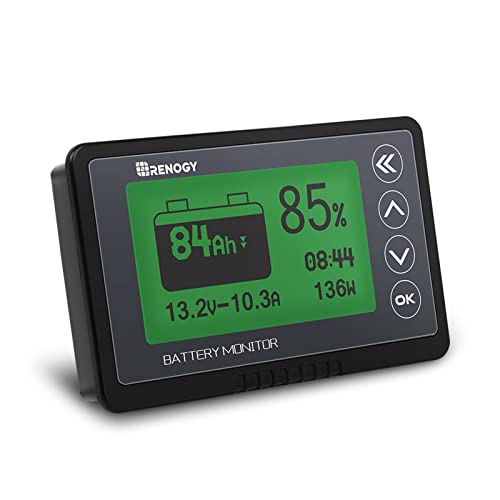
Renogy 500A Battery Monitor with Shunt
$63.10Includes a wired display head, so you get a reading without needing a phone in your hand.
Best for: A panel-mounted readout.
Check price on Amazon
AILI TR16 Shunt Battery Monitor
$42.00The cheapest true shunt-based monitor here, and a cheap shunt still beats an expensive voltmeter for reading lithium.
Best for: A first real state of charge readout.
Check price on AmazonBattery monitor and shunt options

LiTime 500A Bluetooth Battery Monitor
$109.99Covers 8V to 120V, so the same shunt works if you later move the bank to 24V or 48V.
Best for: A build that may change system voltage later.
Check price on Amazon Victron SmartShunt 500A Battery Monitor
Price varies, check the listingA shunt counts amp-hours in and out, which is the only accurate way to read lithium state of charge. Voltage alone cannot do it on a flat discharge curve.
Best for: Any lithium bank you plan to boondock on.
Check price on Amazon Renogy 500A Battery Monitor with Shunt
$63.10Includes a wired display head, so you get a reading without needing a phone in your hand.
Best for: A panel-mounted readout.
Check price on Amazon AILI TR16 Shunt Battery Monitor
$42.00The cheapest true shunt-based monitor here, and a cheap shunt still beats an expensive voltmeter for reading lithium.
Best for: A first real state of charge readout.
Check price on AmazonFrequently asked questions
- What is the LiTime 500A Bluetooth Battery Monitor best for?
- A build that may change system voltage later. Covers 8V to 120V, so the same shunt works if you later move the bank to 24V or 48V. Confirm the current specification on the listing before buying, because manufacturers revise these products without changing the model name.
- Is the LiTime 500A Bluetooth Battery Monitor suitable for a lithium system?
- Check the charge profile before pairing it with lithium. The requirement is a genuine LiFePO4 profile with the correct absorption voltage, not a lead-acid profile with a lithium label. Where a component only charges at lead-acid voltages, a lithium pack will sit permanently short of full.
- What size cable and fuse does it need?
- That depends on the current it carries and the length of the run, not on the component itself. Work out the current from its rating, then size the conductor for both ampacity and voltage drop with the wire gauge calculator, and fuse it at 125 percent of the continuous load rounded up to the next standard rating.
Wiring safety. Never exceed a conductor's rated ampacity, and always fuse a circuit at or below what the wire can carry, because the fuse protects the wire rather than the appliance. Fuse every positive conductor as close to the battery as practical. Use proper crimped lugs and heat shrink rather than twisted joints, support cable so it cannot chafe through on a frame edge, and keep the battery compartment ventilated. Permanent AC wiring is work for a qualified RV technician or a licensed electrician.