Solar
Best RV Solar Charge Controllers: MPPT and PWM for 2026
Researched from published standards and manufacturer specifications. Updated .
Quick answer
The Renogy Rover 40A MPPT with Bluetooth is the best RV solar charge controller for most owners, with user-settable charge parameters that let you dial in a genuine LiFePO4 profile instead of accepting a lead-acid default. Owners running a single 100 watt panel into a small lithium bank can skip MPPT and save money with the Renogy Wanderer Li 30A PWM controller instead, since MPPT's efficiency gain is close to zero on one 12V panel in warm weather.
The charge controller sits between the solar array and the battery, converting the panel's raw output into the correct charging voltage and current for the battery chemistry installed. Getting this component wrong is one of two ways a solar install underperforms even when the panels themselves are sized correctly: either the controller's amperage cannot handle the array's actual current, or its charge profile does not match the battery chemistry, most commonly a lead-acid profile left in place after a lithium battery swap.
This roundup compares MPPT and PWM controllers, the two charge controller technologies used in RV solar. MPPT tracks the panel's optimal operating point and converts excess voltage into usable current, which typically gains roughly 10 to 30 percent more energy harvest than PWM under favorable conditions, largest in cold weather and when panel voltage runs well above battery voltage. That range is an industry convention, not a fixed specification, and on a single 12V panel on a warm day the gain shrinks close to zero, which is exactly the situation where a PWM controller is still the right, less expensive choice.
How we chose these RV charge controllers
We did not test any of these controllers in person. Rankings are based on published amperage ratings, whether the controller offers a genuine, user-settable or pre-programmed lithium charge profile, and verified owner reviews describing real-world reliability and accuracy of Bluetooth reporting where included. We treated MPPT's efficiency advantage over PWM as the industry convention it is, not a fixed number, since actual gain depends heavily on panel voltage and temperature.
MPPT vs PWM: when the upgrade is worth it
MPPT earns its higher price when panel voltage runs meaningfully above the battery's voltage, which happens with panels wired in series or in cold weather when panel voltage rises, and the conventional 10 to 30 percent harvest gain over PWM shows up most clearly under those conditions. On a single 12V panel wired straight to a 12V battery on a warm day, panel voltage and battery voltage are close enough that MPPT has very little advantage to convert, and the gain drops close to zero. Match the controller technology to your actual array configuration rather than defaulting to MPPT because it is the more expensive, more capable-sounding option.
Charge controllers compared
These six controllers split between four MPPT units and two PWM units. Amperage determines the maximum array wattage each can support at a given system voltage.
| Controller | Type | Amps | Bluetooth | Price |
|---|---|---|---|---|
| Renogy Rover 40A MPPT | MPPT | 40A | No | $194.67 |
| Renogy Rover 40A MPPT BT | MPPT | 40A | Yes | $197.40 |
| ECO-WORTHY 40A MPPT BT | MPPT | 40A | Yes | $135.99 |
| Dyness 40A MPPT BT | MPPT | 40A | Yes | $99.99 |
| Renogy Wanderer Li 30A PWM | PWM | 30A | No | $32.99 |
| Renogy 30A PWM LCD | PWM | 30A | No | $61.99 |
Published standard Source: Manufacturer spec sheets on the product listings, current at time of writing..
Why a lithium bank needs a controller with a real lithium profile
A charge controller programmed only for lead-acid chemistries uses absorption and float voltages set lower than LiFePO4 requires, which means a lithium battery connected to it will never reach a true full charge no matter how long it sits in the sun. The Renogy Rover MPPT controllers let you set charge parameters manually to match your specific battery's published voltage requirements, while the Renogy Wanderer Li PWM controller ships with a lithium profile already built in. Either approach works; simply leaving a lead-acid-only controller in place after a lithium battery swap does not.

Renogy Rover 40A MPPT Charge Controller
$194.67User-settable charge parameters mean you can set the correct lithium absorption and float voltages rather than accepting a lead-acid default.
Best for: A lithium bank that needs its own charge profile.
Check price on Amazon
Renogy Wanderer Li 30A PWM Controller
$32.99One of the few low-cost PWM controllers with a genuine lithium charge profile rather than a lead-acid one relabeled.
Best for: A small lithium bank behind one or two panels.
Check price on AmazonDo not trust the word lithium on a listing alone
Plenty of budget PWM controllers advertise compatibility with lithium batteries in the listing title without publishing the actual absorption and float voltages the controller uses for that setting. A genuine lithium profile should specify voltages consistent with LiFePO4's charging requirements, not simply a lithium mode toggle with no documented numbers behind it. When a listing does not publish those voltages, verified owner reviews describing measured charge voltages, or reaching out to the manufacturer directly, are better evidence than the word lithium printed on the box.
Sizing a controller's amperage to your array
A 40A controller on a 12V system carries roughly 520 watts of panel wattage before hitting its rated limit, which is why 40A is the common choice for a 400W to 500W roof array with some room to grow. Apply the conventional 0.75 derate for a flat RV roof when estimating real-world output, and check your specific array wattage against controller amperage with a charge controller calculator before assuming a given controller has headroom for additional panels using a solar array calculator.
Array wattage each controller amperage supports, at 12V and 24V
A controller's maximum supported array wattage follows directly from its rated amperage and the system's nominal voltage, using the standard electrical relationship of watts equals amps multiplied by volts. These are theoretical maximums from that calculation, not a guarantee of real-world harvest, which is always reduced further by panel losses and the roof derate covered elsewhere on this site.
| Controller rating | At 12V | At 24V |
|---|---|---|
| 30A | 360W | 720W |
| 40A | 480W | 960W |
Published standard Source: Calculated using the standard electrical formula watts equals amps multiplied by volts, applied to each controller's rated amperage.. Manufacturers typically recommend leaving headroom below this theoretical maximum rather than running a controller at its absolute limit.
What a charge controller will not do
No charge controller, MPPT or PWM, can charge a battery faster than the array's actual current output allows, regardless of how high the controller's own amperage rating goes, since the controller can only pass along what the panels are producing. A 40A controller paired with a single 100W panel will never approach 40A of charging current, and buying a larger controller than your array requires does not speed up charging. Controller amperage should match your planned array size, including reasonable room for future expansion, not be bought as large as budget allows on the assumption that bigger always charges faster.
Set the correct absorption and float voltage for your specific battery chemistry, not a generic default. A controller left on a generic or incorrect setting can chronically undercharge a battery, shortening its usable life and leaving less capacity available than the battery is actually capable of delivering.
The best RV solar charge controllers by tier
Do not buy a settable MPPT controller if your system is one panel feeding a small lithium bank. MPPT's efficiency advantage is smallest exactly in that scenario, and a PWM controller with a genuine lithium profile, like the Renogy Wanderer Li, does the job for a fraction of the price.
Renogy Wanderer Li 30A PWM Controller
$32.99One of the few low-cost PWM controllers with a genuine lithium charge profile built in rather than a relabeled lead-acid one.
Best for: A small lithium bank behind one or two panels.
Check price on Amazon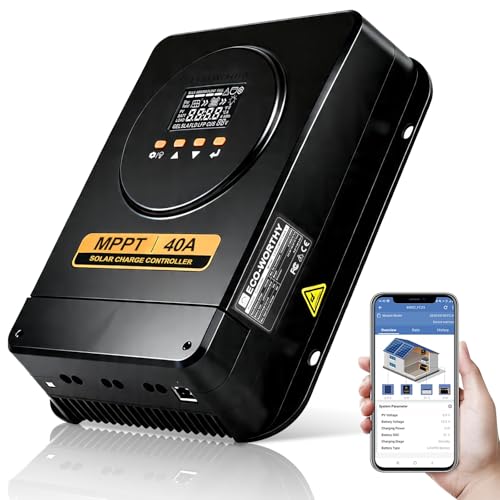
ECO-WORTHY 40A MPPT with Bluetooth
$135.99A 40A MPPT controller with Bluetooth reporting at a lower price than the premium options here, sized to carry a 400W to 500W roof array.
Best for: A 400W to 500W roof array on 12V.
Check price on Amazon Renogy Rover 40A MPPT Charge Controller
$194.67User-settable charge parameters let you set the correct lithium absorption and float voltages exactly, rather than accepting a factory lead-acid default.
Best for: A lithium bank that needs its own charge profile.
Check price on AmazonFrequently asked questions
- Is MPPT always better than PWM?
- MPPT generally harvests more energy than PWM, but the actual gain depends on conditions: it is largest in cold weather and when panel voltage runs well above battery voltage, and it shrinks close to zero on a single 12V panel wired to a 12V battery on a warm day. For a small, simple system, a PWM controller with the correct battery chemistry profile can be the more sensible and less expensive choice.
- What amperage charge controller do I need for a 400 watt array?
- A 400W array on a 12V system draws roughly 33 amps at peak output before accounting for losses, which is why a 40A controller is the common choice, leaving some headroom above the calculated draw. Always calculate the specific amperage for your array's voltage configuration rather than assuming a round number, since series-wired panels change the voltage and current math.
- Does a PWM controller work with a lithium battery?
- It can, provided the specific PWM controller offers a genuine lithium charge profile, like the Renogy Wanderer Li in this roundup. A generic PWM controller built only for lead-acid chemistries will undercharge a lithium battery in the same way a lead-acid-only MPPT controller would, so check for an explicit lithium setting before assuming compatibility.
- Can I use a 12V controller on a 24V system?
- No, not unless the specific controller is rated for auto-detection or manual selection of multiple system voltages, which several of the controllers in this roundup, including the Renogy Rover MPPT units, do support. Check the controller's published system voltage rating before wiring it into anything other than a straightforward 12V setup.
- Do I need Bluetooth on a charge controller?
- Bluetooth reporting lets you verify your array is actually producing the output you sized it for, without opening a panel-mounted display or guessing from battery voltage alone. It is a convenience feature rather than a requirement, and controllers without it, like the standard Renogy Rover 40A MPPT, perform the core charging function identically to the Bluetooth version.
- Where should a charge controller be mounted?
- Charge controllers should be mounted indoors, in a dry, ventilated location close to the battery bank to keep the wire run short, and away from direct sunlight or extreme heat that can affect the controller's internal temperature sensing. Many owners mount the controller inside a battery compartment or a dedicated electrical bay near the batteries it charges.
Confirm the lithium profile before you confirm the amperage. An undersized controller limits how much power you can harvest, but the wrong charge profile silently limits how full your battery ever gets, and that mistake is far easier to miss until months of reduced capacity have already gone by.