Batteries
Best RV LiFePO4 House Batteries for 2026
Researched from published standards and manufacturer specifications. Updated .
Quick answer
The Dyness 12V 100Ah LiFePO4 with Bluetooth is the best all-around RV lithium house battery for most owners, pairing a Group 31-class 100Ah pack with app-based state of charge reporting so you do not need a separate shunt on day one. Owners who camp below freezing should choose a self-heating pack instead, such as the Redodo 100Ah Self-Heating LiFePO4, because a standard lithium BMS refuses to charge below freezing.
An RV house battery bank runs the lights, the water pump, the vent fans, and usually an inverter, and lithium iron phosphate has become the default upgrade path because it delivers roughly twice the usable capacity of the same-sized lead-acid battery, at a fraction of the weight. That capacity gain is not free of conditions, though. A LiFePO4 pack has a battery management system that will refuse to accept charge below freezing unless the pack is self-heating or you add a separate low-temperature cutoff, and every charge source feeding it, the converter, the solar controller, and any DC-DC charger from the tow vehicle, has to carry a genuine lithium charge profile rather than a lead-acid one left in place from the old battery.
This roundup compares 100Ah and 200Ah LiFePO4 packs plus dedicated self-heating models by the specifications that actually decide whether a battery works in your rig: the case size against your existing battery tray, the continuous amperage the built-in BMS can pass, and whether the battery reports its own state of charge over Bluetooth. Picks are grouped into beginner, intermediate, and expert tiers so you can match the spend to what your setup actually needs instead of buying features you will not use.
How we chose these RV lithium batteries
We did not test any of these batteries in person. Rankings come from published manufacturer specifications, BCI group case dimensions, continuous and peak BMS amperage ratings, and verified owner reviews on capacity retention and BMS behavior in cold weather. Where a manufacturer did not publish a figure, such as an independently verified cycle count, we say so rather than repeating a marketing number as fact.
Will a lithium battery fit in your existing battery box?
Case size is the first filter, not capacity. A battery sold as Group 24 or Group 31 is built to drop into the tray already cut for a lead-acid battery of that size, which is why the Super Empower 100Ah pack and the Vemdia and GRNOE 100Ah packs are each sold by group size rather than by dimensions alone. Measure your existing battery box before ordering, and run your daily loads through a battery bank calculator to confirm 100Ah is actually enough capacity before you commit to a case size.
100Ah LiFePO4 batteries compared
All five of these are 100Ah, 12V packs with the same 1280Wh nominal energy rating on paper. The differences that matter are the BMS continuous amperage, which caps how big an inverter you can run, and whether the battery includes its own Bluetooth reporting.
| Battery | BCI group | BMS amps | Bluetooth | Price |
|---|---|---|---|---|
| Super Empower 100Ah | Group 24 | 100A | No | $182.99 |
| Dyness 100Ah | Not published | Not published | Yes | $199.98 |
| HeyFuture 100Ah | Not published | 100A | Yes | $159.99 |
| Vemdia 100Ah | Group 31 | 100A | No | $153.99 |
| GRNOE 100Ah | Group 31 | 100A | No | $159.00 |
Published standard Source: Manufacturer spec sheets on the product listings, current at time of writing.. Dyness does not publish a continuous BMS amperage figure on its listing, so it is marked not published rather than assumed.
Stepping up to a 200Ah bank
A 200Ah bank makes more sense than two separate 100Ah batteries once your daily draw crosses roughly 100Ah, since one larger case is simpler to wire and mount than a parallel pair. The Yeagulch and Dumfume 200Ah packs both publish a 200A continuous BMS rating, which matters if you are running a 2000W inverter that can pull close to 200A from a 12V bank at full load. The NewtiPower 200Ah pack is priced lower but its BMS is rated at 150A, which pairs better with a 1500W inverter than a 2000W one. Read the BMS amperage before the capacity number, because it is the figure that actually limits what you can run.

Yeagulch 12V 200Ah LiFePO4
$316.59A 200A BMS is the spec that matters here, because a 2000W inverter can pull close to 200A from a 12V bank at full load.
Best for: A single-battery bank that has to run a 2000W inverter.
Check price on Amazon
NewtiPower 12V 200Ah LiFePO4
$269.99Rated at a 150A BMS rather than 200A, so it suits a 1500W inverter rather than a 2000W one. Read that limit before buying.
Best for: A large bank behind a modest inverter.
Check price on AmazonWhy a lithium battery needs a lithium-aware charger at every source
Capacity and BMS amperage only matter if the battery actually reaches full charge. A stock RV converter built for lead-acid will stop short of a LiFePO4 pack's absorption voltage and never bring it to 100 percent, and the same is true of a solar charge controller or a DC-DC charger left on a lead-acid profile after a lithium swap. Check every charge source in the rig, not just the newest one, and size the wiring with a DC-DC charger calculator if you are also charging from an alternator. Our best RV DC-DC chargers roundup covers the alternator side of that swap in detail.
Sizing a lithium bank against your actual daily draw
It is easy to buy more battery than you need, or less, when capacity shopping starts from a round number instead of an appliance list. List every load that runs off the battery bank, a residential fridge, vent fans, lighting, any inverter loads, and how many hours each runs on a typical day, then run that list through a daily energy budget calculator before deciding between a 100Ah and a 200Ah pack. A single 100Ah LiFePO4 battery covers a modest daily draw for boondocking without an inverter running large appliances, while two batteries in parallel or a single 200Ah pack suit a rig running a residential fridge and an inverter continuously. Checking your battery run time against a specific appliance list is a more reliable way to size a bank than matching whatever capacity a neighboring rig happens to run.
Self-heating LiFePO4 batteries compared
All four self-heating packs here are 100Ah, 12V batteries with the heating element built into the case. The differences are Bluetooth reporting and price, since none of these listings publish the exact heating element wattage draw independently verified.
| Battery | Capacity | Bluetooth | Price |
|---|---|---|---|
| Redodo 100Ah Heated, Group 31 | 100Ah | No | $278.99 |
| Redodo 100Ah Heated | 100Ah | No | $269.99 |
| LiTime 100Ah Heated | 100Ah | No | $368.99 |
| MARSENERGY 100Ah Heated | 100Ah | Yes | $249.99 |
Published standard Source: Manufacturer spec sheets on the product listings, current at time of writing..
What a 100Ah lithium battery will not do
A single 100Ah LiFePO4 battery, even at the conventional 80 percent usable depth of discharge, holds roughly 1,024Wh of usable energy, which is not enough to run a residential air conditioner for any meaningful stretch of time. Rooftop RV air conditioners typically draw well over 1,000 watts on startup and continue drawing hundreds of watts running, so a single 100Ah battery is sized for lighting, fans, a compressor fridge, and modest inverter use, not climate control. If air conditioning off battery power is the goal, that changes the entire system size, from the battery bank up through the inverter and wiring, and is worth running through a full inverter sizing calculator before assuming any single battery in this roundup is enough on its own.
Never charge a standard LiFePO4 battery below freezing. Charging lithium cells below freezing causes permanent internal damage that a battery management system is designed to prevent by cutting off charging current entirely. A self-heating pack, or a BMS with a genuine low-temperature cutoff, is not a convenience feature in a cold climate. It is the difference between a battery that lasts a decade and one that fails after one cold snap.
The best RV LiFePO4 batteries by tier
Do not buy the self-heating expert tier if you never camp when the battery bay drops below freezing. The heating element draws power from whatever is charging the battery, and paying for a feature you will not use just adds cost and a slightly heavier pack for nothing.
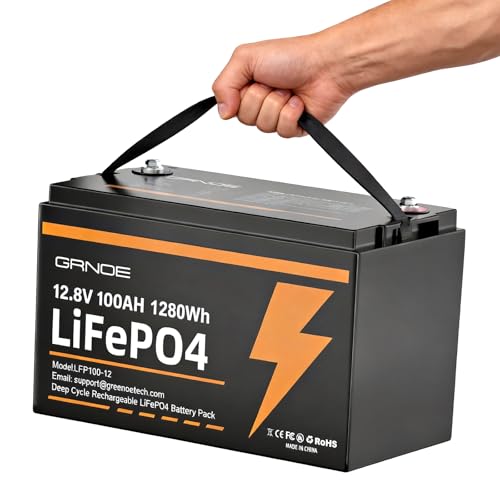
GRNOE 12V 100Ah LiFePO4, Group 31
$159.00A Group 31 case with a published 100A continuous BMS rating at the low end of the price range, enough for a single 1000W inverter.
Best for: Budget-led single battery replacement.
Check price on Amazon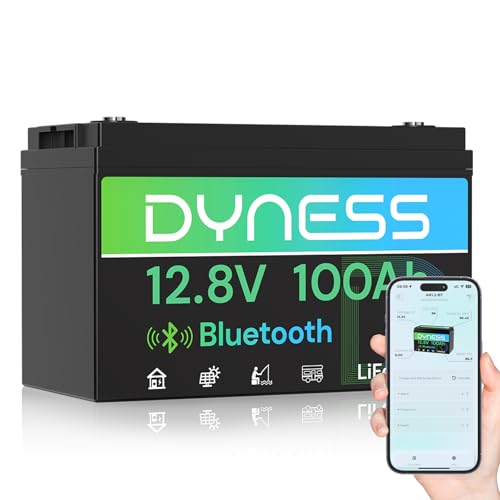
Dyness 12V 100Ah LiFePO4 with Bluetooth
$199.98Bluetooth voltage and state of charge reporting removes the guesswork of reading a lithium pack off a plain voltmeter.
Best for: Owners who want pack data without wiring a shunt on day one.
Check price on Amazon
LiTime 12V 100Ah RV Self-Heating LiFePO4
$368.99LiTime publishes the heating element's activation threshold and draw, so you can budget that load against your solar array instead of discovering it in the field.
Best for: A documented build where the heating current has to be accounted for.
Check price on AmazonFrequently asked questions
- Can I charge a LiFePO4 battery below freezing?
- No, not with a standard pack. The battery management system inside a typical LiFePO4 battery cuts off charging current below freezing to prevent permanent cell damage from lithium plating. A self-heating battery, such as the Redodo or LiTime models in this roundup, warms the cells with a small draw from the charge source before allowing current in, which is what makes charging below freezing possible at all.
- Will a lithium battery fit in my existing battery box?
- Often, yes. Batteries sold by BCI group size, such as Group 24 or Group 31, are built to the same external dimensions as a lead-acid battery in that group, so they generally drop into an existing tray without modification. Always measure your box against the published dimensions on the specific listing before ordering, since not every lithium pack in a given wattage class is built to the same group standard.
- Do I need a special converter for a lithium battery?
- Yes, in almost every case. A stock RV converter built for lead-acid charging uses a lower absorption voltage and will not bring a LiFePO4 pack to full charge, leaving usable capacity on the table indefinitely. Replacing the converter with a unit that has a genuine lithium charge profile, or confirming an existing multi-chemistry converter actually supports LiFePO4, is one of the first steps in any lithium conversion.
- How much usable capacity does a 100Ah LiFePO4 battery really give?
- The rule of thumb used across the industry is roughly 80 percent usable depth of discharge for LiFePO4, which is a convention rather than a published specification, so a 100Ah battery gives approximately 80Ah of practical daily use before recharging. That compares to roughly 50Ah of usable capacity from a 100Ah lead-acid battery under the more conservative 50 percent depth of discharge convention typically applied to that chemistry.
- Is Bluetooth worth paying extra for on a lithium battery?
- It depends on whether you would otherwise add a separate shunt-based battery monitor. Bluetooth reporting built into a battery, like the Dyness and MARSENERGY packs here, gives you voltage and state of charge from a phone app without extra wiring. If you already plan to install a dedicated shunt monitor such as a Victron SmartShunt for more accurate amp-hour counting, the battery's own Bluetooth becomes a nice-to-have rather than a requirement.
- How long does an RV lithium battery last?
- Manufacturers on these listings publish cycle counts as high as 15,000 cycles, but that figure comes from the manufacturer's own data sheet, not from independent lab testing, so treat it as a ceiling under ideal conditions rather than a guarantee. Real-world life depends heavily on avoiding over-discharge, charging below freezing, and storing the battery at a moderate state of charge when the RV is parked for a season.
Check the case size and the BMS amperage before you check the price. A battery that will not physically fit your tray or cannot pass the current your inverter draws is not a bargain no matter what it costs, and a lithium bank installed without a matching charge profile at every source will never reach the capacity you paid for.