Charging
Best RV Converter/Chargers, Including Lithium-Compatible Models
Researched from published standards and manufacturer specifications. Updated .
Quick answer
A converter/charger takes shore power AC and turns it into 12V DC to charge the RV's battery bank and run the 12V lighting and fan circuits while plugged in. It usually lives inside the power center, out of sight, which is exactly why it gets overlooked during a lithium conversion. Swapping in a lithium battery while leaving a lead-acid-profile converter in place is one of the most common mistakes people make, because the battery will never see the charge voltage it needs.
The four units here cover the range from a budget lead-acid-era style unit with basic staged charging to converters built specifically around a lithium profile, plus a genuine drop-in replacement for the WFCO power centers that many trailers already ship with.
What a converter/charger actually does
Unlike an inverter, which turns battery DC into usable AC, a converter/charger runs the opposite direction: it takes 120V AC from shore power or a generator and steps it down to 12V DC, both to charge the battery bank and to directly run the RV's 12V circuits while plugged in. It typically sits inside a power center alongside the breaker panel and is the part most people never think about until a battery swap exposes it.
The lithium mistake: swapping the battery but not the converter
Lithium charge profiles publish an absorption voltage around 14.6V, the figure LiTime lists for its own dedicated lithium chargers, which is meaningfully higher than the fixed setpoint a lead-acid-profile converter typically provides. A lead-acid converter will charge a lithium bank, but it stalls out well short of full and never gets there, which quietly shortens the usable capacity of every trip. This is the single most common mistake in a do-it-yourself lithium conversion: buying the battery and skipping the converter.
What to check before assuming a converter needs replacing
Not every converter swap is necessary. Some newer converters already ship with a selectable or automatic lithium mode, like the WFCO unit's auto-detect switching, so it is worth checking the existing unit's own manual and any dip switches or selector settings before buying a replacement. A converter with a manufacturer-documented lithium charge profile can often stay in place, while one whose documentation only describes a fixed lead-acid setpoint, with no lithium mode mentioned anywhere in the manual, needs to go regardless of how new or expensive it was.
Converter/chargers compared
All four units here are rated at 55A, so the charge profile documentation and the mount style are what actually separate them.
| Converter | Amps | Lithium charge profile | Mount | Price |
|---|---|---|---|---|
| PowerMax PM3-55LK | 55A | Yes, lithium-specific | Deck mount | $133.00 |
| PowerMax PM4-55A | 55A | Yes, selectable output voltage | Deck mount | $143.00 |
| WFCO WF-9855-AD-CB | 55A | Yes, auto-detect lead-acid or lithium | Deck mount | $248.99 |
| VEVOR 55A 4-Stage | 55A | 4-stage, no published lithium documentation | Deck mount | $64.84 |
Published standard Source: Manufacturer published specifications and current listing prices for each unit.. Price drifts over time; treat the amp rating and the documented charge profile as the figures that decide whether a converter is actually safe for a lithium bank.
Deck mount vs power center replacement
All four converters in this roundup are deck mount units, meaning they are designed to be swapped into an existing power center slot rather than mounted freestanding. That matters because most trailers, particularly those built around a WFCO power center, have a specific footprint and connector layout the original converter fills. A genuine WFCO replacement like the WF-9855-AD-CB is built to drop into that exact slot, while a different brand's deck mount unit may need the wiring harness adapted even though it is technically also a deck mount design. Confirm the existing power center's model and connector style before ordering, rather than assuming any 55A deck mount unit is a guaranteed fit.
What a converter cannot do that an inverter/charger can
A converter only moves power in one direction, from AC shore power down to 12V DC. It has no ability to invert the battery's stored DC power back into usable AC when unplugged, which is the entire job of a separate inverter or an inverter/charger. Choosing a standalone converter, as opposed to an inverter/charger, only makes sense when a separate inverter is already in place or planned, since the converter alone leaves the rig with no AC power at all once it is disconnected from shore power or a generator.
Replacing a converter without disturbing the rest of the power center
Most deck mount converters connect through a handful of standardized leads: AC input, 12V DC output to the distribution panel, and a battery connection, often through a common connector block shared with other components in the power center. A like-for-like swap, same amp rating and same mount style, typically means unplugging the old unit's connector block and plugging in the new one, without needing to touch the breaker panel or the 12V distribution wiring at all. A converter with a different mount style or a non-standard connector, on the other hand, can turn what looked like a simple swap into a wiring project, which is why matching the physical connector layout matters as much as matching the amp rating.
Converter noise and fan cycling
A converter's cooling fan typically cycles on and off based on internal temperature, which becomes noticeable inside a small trailer parked in a quiet campground, especially overnight while the converter is actively bulk charging a depleted bank. Deck mount units installed inside a closed power center compartment tend to run quieter than units mounted in open cabinetry, simply because the enclosure dampens the fan noise, though it also means the compartment needs adequate ventilation so the converter itself does not overheat from being enclosed.
Multi-stage charging, and why it matters for battery life
All four converters here advertise multi-stage charging, meaning the charger moves through distinct phases, typically a bulk stage delivering maximum current, an absorption stage holding a steady voltage as current tapers, and a float stage maintaining a lower voltage once the battery is full. Multi-stage charging exists specifically to avoid the battery sitting at a high voltage indefinitely, which shortens the life of both lead-acid and lithium chemistries over repeated cycles. A single-stage charger, which simply holds one fixed voltage regardless of the battery's actual state, is largely a thing of the past in this category, but it is still worth confirming that a given unit's documentation actually describes distinct stages rather than using the term loosely.
How we chose
These picks were researched from published manufacturer specification sheets covering amp rating, charge profile and staging, and mount style, then cross-checked against verified owner reviews for drop-in fit and reported charge behavior on lithium banks. None of these units were tested in person for this page.
Check the converter's charge voltage before trusting it with lithium. A converter without a documented lithium profile may float well below what a LiFePO4 bank needs to reach full charge, which silently reduces usable capacity every single charge cycle without ever throwing an error.
Converter/chargers compared
Compare these first by whether the maker documents a real lithium charge profile, not just by amp rating, since all four sit at 55A.

VEVOR 55A RV Converter with 4-Stage Charging
$64.84Four-stage charging at the lowest price in this group, though it lacks the published lithium charge profile documentation that the PowerMax units provide, so verify the charge voltage before trusting it with a lithium bank.
Best for: A budget converter replacement.
Check price on Amazon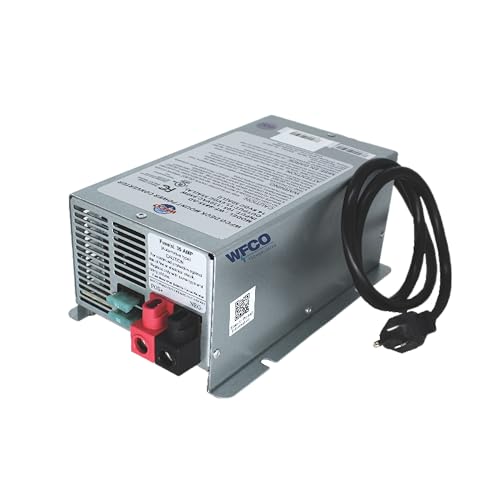
WFCO WF-9855-AD-CB 55A Converter/Charger
$248.99Auto-detect switching between lead-acid and lithium multi-stage charging, and it drops into the WF-9855 slot that most WFCO power centers are already wired for.
Best for: A direct drop-in replacement in a WFCO power center.
Check price on Amazon
PowerMax PM4-55A 55A Converter, Lithium
$143.00Selectable output voltage lets the charge setpoint be matched exactly to the battery pack's own specification instead of accepting a fixed factory setpoint, which is a step most beginners do not need to take.
Best for: A build where the charge voltage has to be set exactly.
Check price on AmazonFrequently asked questions
- Can I use a lead-acid converter with a lithium battery?
- It will not damage most lithium batteries outright, since their BMS protects against overvoltage, but it will chronically undercharge the pack. A lead-acid converter's fixed charge voltage typically sits below what LiFePO4 needs to reach full, so the bank never actually charges completely, which is the most common lithium conversion mistake.
- What does auto-detect mean on the WFCO converter?
- The WFCO WF-9855-AD-CB reads the connected battery and switches between a lead-acid charge profile and a lithium multi-stage profile automatically, rather than requiring a manual switch or dip setting. That makes it useful for anyone who is not fully certain up front which chemistry the converter will always be paired with.
- Do I need a separate DC-DC charger if I already installed a lithium-compatible converter?
- Yes, if the RV also charges from a tow vehicle alternator. A converter only charges from shore power or a generator; it does nothing for alternator charging. A DC-DC charger is a separate, required component any time lithium is charged from the engine while driving, because it limits the current the alternator has to supply.
- How is a converter different from an inverter/charger?
- A converter only charges the battery from shore power; it cannot invert battery power back into AC. An inverter/charger does both jobs plus automatic transfer switching in one enclosure. Choosing a standalone converter usually means a separate standalone inverter is also handling the AC-from-battery side of the system, which is a common and often cheaper way to build the same overall setup in two parts instead of one.
- Will a 55A converter fully charge a 200Ah lithium battery overnight?
- A meaningfully depleted 200Ah bank will take multiple hours at 55A even before the charger tapers current near full, so an overnight plug-in is often enough but not instant. Charge time scales with how depleted the bank is and how the converter's charging stages taper current as the battery approaches full, so a bank that started the evening only partly depleted will finish charging noticeably sooner.
- What voltage should a lithium-compatible converter charge to?
- Dedicated lithium chargers commonly publish an absorption voltage around 14.6V for a 12V LiFePO4 pack, which is the figure manufacturers like LiTime list for their own lithium-specific chargers. A converter's documentation should state its lithium charge voltage explicitly rather than leaving it to be assumed, and that figure is worth confirming with a multimeter at the battery terminals after installation.
Do not mix charge profiles by guesswork. Before leaving any converter charging a lithium bank unattended, confirm its charge voltage in its own manual and compare it against the battery's documented requirement. A mismatch will not usually damage the battery, but it will quietly rob the bank of usable capacity every single trip.