Inverters
Best RV Pure Sine Power Inverters, Sized to Your Battery Bank
Researched from published standards and manufacturer specifications. Updated .
Quick answer
A power inverter turns the 12V DC stored in your battery bank into the 120V AC that a residential fridge, a microwave, a laptop charger, or a coffee maker expects. Every inverter worth buying for an RV is a pure sine unit, which produces the same clean waveform as a utility outlet. A modified sine unit is cheaper but can overheat motors and confuse the charging circuits in phones and laptops, so it does not belong on this list at all.
The harder question is not waveform, it is size. A 1000W inverter, a 2000W inverter, and a 3000W inverter are not just different price points, they pull very different current from the battery bank underneath them, and that current is what actually decides whether the install works.
How big an inverter does an RV actually need?
Start from the loads, not the inverter. A residential compressor fridge typically runs on a few hundred watts but can surge past 1200W for a second or two on startup. A microwave draws 1000W to 1500W continuously while it runs. A coffee maker or hair dryer can pull 1200W to 1500W on its own. Stack a fridge and a microwave together and a 1000W inverter is already short; that is why 2000W is the common middle ground for a trailer that wants to run a fridge plus one more appliance at a time.
A 3000W inverter only makes sense once the goal is running an air conditioner or several heavy loads together, and at that point the battery bank and cabling become the more expensive part of the project. Run the actual appliance list through an inverter sizing calculator before picking a wattage class, since guessing tends to land people on either an inverter that trips constantly or one that is oversized for a bank that cannot feed it.
What a 2000W inverter really pulls from a 12V battery bank
DC current draw for an AC load scales with inverter efficiency and system voltage, not just the wattage printed on the box. Using a published 85 percent efficiency figure, a convention for pure sine inverters at full load, and 12V nominal system voltage, the current a fully loaded inverter pulls from the battery bank looks like this.
| Inverter class | Continuous watts | Typical surge watts | Approx. DC draw at full load | Minimum bank/BMS rating |
|---|---|---|---|---|
| 1000W class | 1000W | 2000W | ~98A | 100A continuous |
| 2000W class | 2000W | 4000W to 6000W | ~196A | 200A continuous |
| 3000W class | 3000W | 6000W | ~294A | 300A continuous, or a paralleled bank |
Convention Source: Calculated from a published 85 percent inverter efficiency figure (convention) at 12V nominal system voltage. Individual units may vary; see each product's own published continuous and surge ratings above.. Real draw shifts with battery voltage under load and actual inverter efficiency at that load. Treat these as planning figures, and check them against the battery bank's own BMS rating before wiring anything.
Pure sine vs modified sine: why the waveform is not a footnote
A pure sine inverter produces a smooth waveform that matches what a utility outlet delivers. A modified sine inverter approximates that waveform with stepped voltage, which is cheaper to build but can overheat induction motors, cause an audible hum in some electronics, and confuse the charging circuitry in laptops and phones. For that reason this catalog is pure sine only. Notably, the Xantrex Freedom 458 inverter/charger, a unit some RVers already own, is a modified sine design and is deliberately excluded here for that reason, not because of brand or price. Anyone upgrading from an older modified sine setup should treat the swap to pure sine as a genuine reliability upgrade for sensitive electronics, not just a nicer-sounding spec on a box.
Sizing the breaker and cable, not just the inverter
The inverter's DC input needs a fuse or breaker sized for its full continuous draw, not its typical use. NEC 210.20(A) sets overcurrent protection at 125 percent of a continuous load, which is the standard most manufacturers reference when they publish a recommended fuse size for a given inverter. A 2000W inverter drawing roughly 196A continuous therefore wants a fuse rated well above that, sized per the manufacturer's own installation manual, plus cable heavy enough to carry that current over the actual run length without overheating. Run the numbers through a wire gauge calculator and a fuse size calculator before buying cable, since undersizing either one is a fire risk, not just a performance loss.
Cable length matters as much as the amp rating. The same 4 AWG cable that easily carries 196A over a 2 foot run between a battery and a busbar can drop enough voltage to cause problems over a 10 foot run to a remotely mounted inverter. A voltage drop calculation, not just an amp rating chart, is what tells you whether a given gauge is actually adequate for the specific distance in your install, and it is worth running before cutting any cable.
Running air conditioning on inverter power
A 3000W inverter is usually the entry point for running a rooftop air conditioner off the battery bank instead of a generator, since a typical rooftop unit has a startup surge that a 2000W inverter's surge rating often cannot cover even on a good day. Even at 3000W, many installers pair the inverter with a soft start device wired into the air conditioner itself, which cuts the compressor's startup current spike so the inverter and the battery bank underneath it never actually see the full surge number. Skipping that pairing is a common reason a 3000W inverter still trips on air conditioner startup even though its continuous rating looks like more than enough on paper.
This is also where the battery bank's chemistry and BMS rating stop being a formality. Running a rooftop air conditioner off a 3000W inverter for any length of time means sustaining close to 294A from the bank, which a single small lithium battery with a 100A BMS simply cannot supply. That load calls for either a battery built with a BMS rated at 300A or higher, or multiple batteries wired in parallel with their combined continuous rating checked against the draw, not just their combined amp-hour capacity.
Hardwired vs plug-in installation
Smaller inverters, typically 1000W units, are often installed with a plug-in AC outlet built into the case, so an extension cord or a short jumper feeds power to whatever is plugged in nearby. Larger 2000W and 3000W inverters are usually hardwired directly into a sub-panel or a dedicated circuit instead, both because their output is meant to feed the RV's existing outlets rather than one nearby appliance, and because a hardwired connection avoids relying on a cord and plug rated for that much continuous current. Check which style a given unit ships with before assuming it will drop into an existing setup without any additional wiring work.
How we chose
These picks were researched from published manufacturer specification sheets (continuous watts, surge watts, waveform, listing and certification marks) and cross-checked against verified owner reviews for real-world reliability patterns like nuisance shutdowns and idle draw. None of these units were tested in person for this page; where a manufacturer had not published a figure, it is marked as not published rather than estimated.
Match the inverter to the bank, not the other way around. A 2000W or 3000W inverter is not properly sized until its DC amp draw at full load has been checked against the battery bank's continuous discharge rating and its BMS's continuous amp rating. A mismatch here is the most common reason an inverter trips or a BMS shuts the bank off mid-use.
Pure sine inverters by wattage class
These are grouped by wattage class rather than brand, because the number that decides fit here is watts, and the DC amp draw that follows from it, not the label on the case.
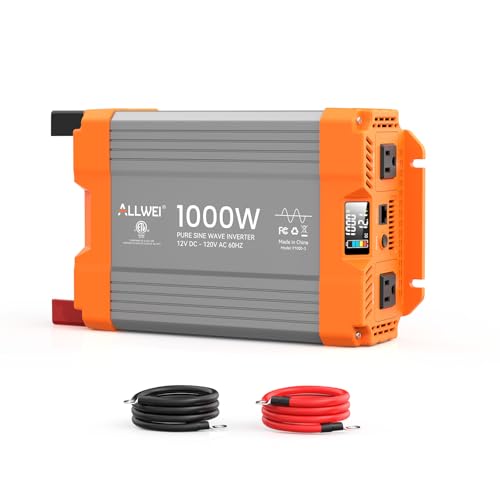
ALLWEI 1000W Pure Sine Inverter, ETL Listed
$89.971000W is plenty for tools, a laptop, and small electronics, and the ETL listing to UL 458 gives a budget inverter a real safety listing behind it rather than none at all.
Best for: A budget inverter with a real listing behind it.
Check price on Amazon
BELTTT 2000W Pure Sine Inverter
$161.99A published 4000W surge rating gives real headroom for a compressor startup spike, at a lower price than the Renogy while still landing at the same 2000W continuous class.
Best for: A residential fridge plus occasional high draw.
Check price on Amazon
Renogy P2 3000W Pure Sine Inverter
$414.993000W is for a build aiming to run air conditioning off the inverter, which also means roughly 294A of DC draw at full load. Skip this unless the battery bank and cabling are already sized for that current.
Best for: A large lithium bank where air conditioning on inverter is the goal.
Check price on Amazon
BELTTT 3000W Pure Sine Inverter
$212.49The lower-cost route to 3000W continuous with a 6000W surge rating, though the heavy cable and large bank it demands will cost more than the inverter itself.
Best for: Motor loads with a large startup spike.
Check price on AmazonFrequently asked questions
- What size inverter do I need for a residential RV refrigerator?
- A 1000W to 1500W inverter covers most residential compressor fridges on their own, since running draw is usually a few hundred watts with a brief surge near 1200W on startup. Sizing up to 2000W is common so the fridge can run alongside a laptop charger or small kitchen appliance without the inverter approaching its continuous limit.
- Can a 2000W inverter run a microwave and a coffee maker at the same time?
- Usually not at full power on both. A microwave can draw 1000W to 1500W and a coffee maker 1200W to 1500W, so running both together can exceed a 2000W continuous rating even before adding a fridge. Stagger heavy loads, or size up to a 3000W class inverter with the battery bank to support it.
- Why does my inverter shut off even though the battery still shows charge on the panel?
- This is almost always a current limit, not a charge limit. A high draw appliance can pull the inverter's DC current past what the battery's BMS allows, and the BMS disconnects to protect the cells even though the stated state of charge is fine. Checking the appliance's real draw against both the inverter's and the battery's amp ratings usually finds the mismatch.
- Is a modified sine inverter ever good enough for an RV?
- It can run simple resistive loads like an incandescent bulb or a basic heater, but it risks overheating motors and can damage or confuse the charging circuits in laptops, phones, and some microwaves. Pure sine costs more but matches utility power exactly, which is why every inverter on this page is a pure sine unit.
- Does an inverter draw power from the battery when nothing is plugged in?
- Yes. Every inverter has an idle draw, typically a small number of watts, just to keep its electronics and display active. Left on for days at a campsite with nothing plugged in, that idle draw can meaningfully drain a battery bank. Most inverters include a remote on/off switch specifically so it can be shut down between uses.
- What is the difference between continuous watts and surge watts on an inverter?
- Continuous watts is what the inverter can supply indefinitely without overheating or shutting down. Surge watts is a much higher figure the inverter can supply for a second or two, which is what actually gets a motor or compressor started. Both numbers matter: continuous decides ongoing capacity, surge decides whether a fridge or pump will start at all, and a unit that looks undersized on continuous watts alone may still fail on startup if its surge rating is also too low to cover the appliance being plugged in.
An inverter is only as safe as the cable and fuse feeding it. Undersized cable or a missing DC fuse at the battery is one of the more common causes of inverter-related wiring damage in RV installs. Size both to the inverter's full continuous draw, not its average day-to-day use, and follow the manufacturer's own installation manual for fuse placement.