Systems
Surge Protector vs EMS for RVs: Why the EMS Is Worth It
Researched from published standards and manufacturer specifications. Updated .
Quick answer
A plain surge protector reacts to a voltage spike only. A full EMS, or electrical management system, also disconnects on sustained low voltage, high voltage, an open ground, and reverse polarity, all of which are more common at a busy campground than a lightning strike. Low voltage from an overloaded pedestal on a hot afternoon destroys a compressor just as surely as a surge does, which is why an EMS is worth the extra cost over a basic surge protector.
These two get sold in the same aisle and often look identical, a box that plugs into the pedestal before the shore power cord runs to the rig, but they protect against different failure modes. A basic surge protector is built to absorb a voltage spike, the kind caused by a lightning strike nearby or utility switching, and that is genuinely useful, but it is also a comparatively rare event. An EMS does that plus continuously monitors the pedestal for sustained low voltage, sustained high voltage, a missing or open ground, and reverse polarity, disconnecting the rig before any of those conditions reach the appliances.
The products actually sold as RV surge protectors today, including every model referenced on this page, are built as full EMS units precisely because the low voltage and wiring fault scenarios turn out to be the more common and more damaging ones in real campground conditions. A generic hardware-store surge suppressor without that monitoring logic is the option to avoid.
Is a surge protector the same thing as an EMS?
No, and the naming is genuinely confusing because retailers often use the terms loosely. A true surge protector, in the narrow sense, only clamps a voltage spike. An EMS does that and also actively monitors the pedestal's ongoing voltage and wiring integrity, disconnecting the rig the moment a sustained fault appears rather than only reacting to an instantaneous spike. Every product worth buying in this category today is built as a full EMS, which is also why the products referenced throughout this page are all EMS units rather than plain surge suppressors.
Surge protector vs EMS, side by side
The gap between the two is entirely in what gets detected before damage happens, not in build quality or price alone.
| Protection type | Basic surge protector | Full EMS |
|---|---|---|
| Protects against a voltage spike | Yes | Yes |
| Disconnects on sustained low voltage | No | Yes |
| Disconnects on sustained high voltage | No | Yes |
| Detects an open or missing ground | No | Yes |
| Detects reverse polarity | No | Yes |
| Response to a sagging, overloaded pedestal | Nothing, passes the low voltage through | Cuts power before it reaches the panel |
| Typical price in this catalog | Not carried, since a plain unit skips the protections above | $136 to $305 |
Convention Source: Feature comparison drawn from Progressive Industries and Power Watchdog published EMS feature lists for the specific models referenced on this page..
Why low voltage is the more common killer
A lightning-induced surge is dramatic but rare. A sagging, overloaded pedestal on a hot afternoon, with every rig in the park running air conditioning off the same transformer, is common, and it is genuinely dangerous to a compressor. Motors draw more current at low voltage to produce the same work, which overheats windings and shortens compressor life with every occurrence, even when nothing visibly trips or fails that day. A plain surge protector does nothing in that scenario because there is no spike to clamp, the voltage just quietly sags below what the equipment needs. An EMS watches for exactly that condition and disconnects before the compressor pulls the extra current.
What the EMS actually does when it trips
When an EMS detects a fault, it disconnects the rig from shore power and typically holds that disconnect through a delay period even after the condition clears, rather than reconnecting the instant voltage looks acceptable again. That delay protects a compressor from an immediate restart into unstable power, which is the same reason a compressor should never be restarted immediately after any power interruption. The display or app on most EMS units also shows which condition tripped it, low voltage, high voltage, open ground, or reverse polarity, so you know whether the problem is the pedestal or something in the rig.
How to actually use an EMS at the pedestal
Plug the EMS directly into the pedestal outlet first, before connecting the shore power cord from the rig to the EMS, and check its display or indicator lights for a pass condition before proceeding. Skipping this order, or plugging the rig in first and the EMS second, defeats the entire point, since the rig could already be exposed to a fault during that window. Once connected, glance at the EMS periodically during a stay, especially on hot afternoons when every site in the park is likely running air conditioning at once, since that is exactly when a shared transformer sags into a low voltage condition. If the unit trips, resist the urge to immediately reset it and reconnect, wait through its built-in delay and confirm pedestal voltage has actually stabilized, since forcing a reconnect into the same unstable condition defeats the protection the delay is providing in the first place.
What each fault type actually does to your appliances
The four conditions an EMS watches for are not interchangeable risks, each one damages the rig in a different way, which is worth understanding rather than treating the EMS as one generic safety box.
| Fault condition | What it typically damages | Caught by a plain surge protector? |
|---|---|---|
| Voltage spike | Electronics, control boards, chargers with weak input protection | Yes, this is what it is built for |
| Sustained low voltage | Compressor motors, air conditioners, the residential fridge | No |
| Sustained high voltage | Anything with a heating element or a sensitive power supply | No |
| Open or missing ground | No direct appliance damage, but a real shock hazard on the chassis | No |
| Reverse polarity | Can energize the neutral or ground path incorrectly, a shock and fire risk | No |
Convention Source: General electrical fault behavior as described in Progressive Industries and Power Watchdog EMS documentation for the fault types their units detect..
The one case where a plain surge protector might be enough
If a rig is permanently parked at a single home site with pedestal wiring that has already been checked and verified correct, the open ground and reverse polarity risks that make an EMS worth it elsewhere are largely already ruled out, which narrows the remaining risk to voltage spikes and to the utility's own supply stability, something a homeowner can also monitor another way. Even then, the low voltage risk on a hot day from a shared transformer or an aging local grid does not go away just because the wiring itself is sound, which is why most people who travel between different campgrounds and pedestals of unknown quality are still better served buying the EMS rather than the plain unit.
EMS picks by amperage and monitoring level
All four of these are full EMS units, not plain surge protectors, because that is genuinely the right category to buy from. The choice between them comes down to amperage and whether you want live monitoring on a phone.

Progressive Industries EMS-PT30X, 30A
$135.89Disconnects on low voltage, high voltage, open ground, and reverse polarity, the fault set a plain surge protector cannot detect at all.
Best for: Anyone plugging into parks they have not vetted.
Check price on Amazon
Progressive Industries EMS-PT50X, 50A
$187.15Monitors both legs of a 50A split-phase service independently, since a fault on one leg is invisible if only the other is being watched.
Best for: Any 50A rig.
Check price on Amazon
Power Watchdog PWD30 Bluetooth, 30A
$139.99Reports actual pedestal voltage and current to a phone, which lets you see a sagging pedestal trending down before it trips a disconnect.
Best for: Watching pedestal quality over a long stay.
Check price on Amazon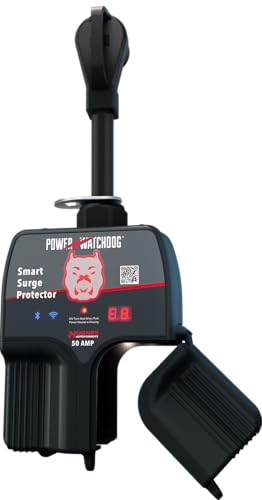
Power Watchdog PWD50W Smart, 50A
$249.99Per-leg current reporting on a 50A service, useful for confirming the two legs are carrying a balanced load.
Best for: Diagnosing which leg is carrying the air conditioners.
Check price on AmazonFrequently asked questions
- What's the actual difference between a surge protector and an EMS?
- A surge protector only reacts to a voltage spike. An EMS continuously monitors the pedestal and also disconnects on sustained low voltage, high voltage, an open ground, and reverse polarity, none of which a plain surge protector can detect. Every current RV product in this category is sold as a full EMS for that reason.
- Can a plain surge protector catch a low voltage problem?
- No, a plain surge protector has no monitoring logic for sustained voltage levels, only a component that clamps a sudden spike. Low voltage from an overloaded pedestal passes straight through to the rig's appliances undetected, which is exactly the scenario an EMS is built to catch.
- Do I need an EMS if my usual campground always seems fine?
- Yes, because the failure modes an EMS catches, open ground and reverse polarity especially, come from pedestal wiring faults that can exist for years without an obvious symptom until something plugs in and gets damaged or someone gets shocked. A park that has always seemed fine is not the same as a park with verified correct wiring.
- Is a portable or hardwired EMS better?
- A hardwired EMS installed inside the rig cannot be left behind or stolen off the pedestal, which is the main failure mode of portable units left outside unattended. A portable EMS is easier to move between vehicles or lend out, so the right choice depends on whether theft risk or flexibility matters more to you.
- How much more does an EMS cost than a basic surge protector?
- EMS units in this catalog run from about $136 to over $300 depending on amperage and monitoring features, generally more than a bare surge-only device would cost. Given that low voltage damage to a compressor is both common and expensive to repair, that difference is small relative to the risk it removes.
- Does an EMS protect against generator power too?
- An EMS is designed primarily to monitor a shore power pedestal connection, and most units will also flag obvious faults when connected to a generator. Preventing a generator from being connected to shore power at the same time is a separate job handled by a transfer switch, not by the EMS itself.
Safety note. Open ground and reverse polarity detection are not just equipment protection, they are life safety features, since a miswired pedestal can put a shock hazard on the rig's chassis or appliances. Always plug the EMS in first and confirm it shows a pass before connecting anything else, and never bypass a tripped EMS to force a connection.