Shore power
Best 50 Amp RV Surge Protectors and EMS Units
Researched from published standards and manufacturer specifications. Updated .
Quick answer
The Progressive Industries EMS-PT50X is a strong starting point for 50 amp RV protection because it is a full electrical management system that watches both power legs independently for low voltage, high voltage, open ground and reverse polarity, then disconnects before damage happens. A 50 amp RV service is two separate 120 volt legs rated at 50 amps each, about 12,000 watts combined, more than three times a 30 amp service.
A 50 amp RV service is not a bigger version of 30 amp service, it is a different kind of circuit entirely: two separate 120 volt legs, each rated at 50 amps, for roughly 12,000 watts combined. That is what lets a 50 amp coach run two air conditioners and a residential-size converter at once without the load management a 30 amp rig needs. It also means a surge protector or EMS built for 50 amp service has to watch both legs independently, because a fault on one leg is invisible if the unit is only monitoring the other.
All three units below are full EMS units rather than plain surge protectors, which is the category worth paying for at any amperage. The differences between them come down to how they report what they see and whether they are meant to be portable or wired permanently into the coach.
Why is 50 amp service more than 30 amp service, not just a little more?
A 30 amp RV service is one 120 volt leg rated at 30 amps, about 3,600 watts. A 50 amp RV service is two separate 120 volt legs, each rated at 50 amps, for roughly 12,000 watts combined. That is a NEMA 14-50 rated circuit at the pedestal, and it is more than three times the capacity of a 30 amp NEMA TT-30 circuit, not the 67 percent bump the raw amp numbers might suggest. The practical effect is that a 50 amp coach can run two rooftop air conditioners, a residential-size converter and normal household loads at the same time, something a 30 amp rig simply cannot do regardless of how carefully the load is managed.
How we chose these 50 amp EMS units
We did not test these units in person. These picks come from published manufacturer specifications, the fault thresholds each brand documents in its own manuals, and verified owner reviews describing performance at real pedestals over time. No figure on this page was invented to fill a gap the manufacturer left blank.
50 amp EMS comparison
All three units monitor both legs of a true 50 amp service, so the table below focuses on how each one is meant to be installed and how it reports what it finds.
| Model | Legs monitored | Install | Monitoring | Price |
|---|---|---|---|---|
| EMS-PT50X | 2 | Portable, plug-in | Digital display, no app | $187.15 |
| Power Watchdog PWD50W | 2 | Portable, plug-in | WiFi and Bluetooth app, per-leg current | $249.99 |
| EMS-HW50C | 2 | Hardwired, behind panel | Digital display, no app | $169.99 |
Published standard Source: Manufacturer specification sheets; 50A two-leg rating per NEMA 14-50 device standard.. Prices reflect the listing at time of writing and can change.
What actually trips a 50 amp EMS?
Four conditions cover almost every real fault: voltage too low, voltage too high, an open ground, and reverse polarity, where hot and neutral are swapped at the pedestal. Low voltage is the quiet one; a compressor pulling full current at 105 volts on a leg draws more amps than it would at 120, runs hotter, and shortens its own life without ever tripping a breaker. An EMS with a low voltage cutoff on both legs is what actually prevents that failure mode, which a plain surge protector cannot see at all, since it only reacts to spikes above normal voltage, never below it.
Portable versus hardwired at 50 amp
A portable EMS plugs in between the pedestal and your cord and travels with the coach, which is the simpler choice for most owners and requires zero installation. A hardwired EMS is wired in behind the distribution panel by a qualified installer and cannot be lifted off an unattended pedestal, which matters if the rig sits at a site unattended for stretches of the season. Both protect the same four fault conditions; the choice comes down to installation effort and theft risk at your specific site, not electrical capability.
Sizing an EMS to a coach running two air conditioners
A 50 amp coach with two rooftop air conditioners typically splits them across the two legs so that neither leg carries both compressors' starting surge at once, which is one reason the electrical panel behind most 50 amp coaches routes air conditioners to opposite legs by design. An EMS that reports current on each leg separately, rather than a single combined number, is what lets you actually verify that split is working as intended instead of assuming it. If one leg consistently reads far higher current than the other while both air conditioners are running, that imbalance is worth investigating before it trips a breaker at an inconvenient moment, and a per-leg reporting unit is the tool that surfaces the problem in the first place rather than leaving you to guess from a tripped breaker after the fact.
Does a 50 amp EMS work at a park with only 30 amp pedestals?
No, not directly. A 50 amp EMS is built around a NEMA 14-50 connector rated for two 120 volt legs, and a 30 amp pedestal only has a single TT-30 leg to offer. Traveling between 30 amp and 50 amp sites means carrying both a 30 amp rated EMS and a 50 amp rated EMS, along with the correct dogbone adapter for whichever direction the mismatch runs, rather than expecting one EMS to cover both service types.
Why do some parks advertise 50 amp sites but deliver sagging voltage?
Some campgrounds advertise 50 amp sites but the pedestal wiring, or the transformer feeding a whole loop of sites, cannot actually deliver full 50 amp capacity to every site at once, especially during peak demand when many coaches are running air conditioners simultaneously. An EMS with voltage monitoring is what catches this in practice: sagging voltage under load is the symptom of a pedestal or feeder that is undersized for the number of sites drawing from it, even though the receptacle itself is the correct NEMA 14-50 type. This is exactly the low voltage condition an EMS disconnects on, which is why the fault shows up as a shutdown rather than as damage to the coach.
Never back-feed a generator into a 50 amp pedestal connection. An automatic transfer switch makes shore power and generator power mutually exclusive; running both at once risks feeding current back into utility lines that line crews may believe are dead.
Best 50 amp EMS units by experience level
Every option here is a full electrical management system built for a two-leg 50 amp service, so choose based on how you want the unit to report faults and whether portability or a permanent install matters more to you.

Progressive Industries EMS-PT50X, 50A
$187.15Plugs in between the pedestal and your cord with no wiring and no app required, protecting both legs from the first day you own it.
Best for: Any 50A rig.
Check price on Amazon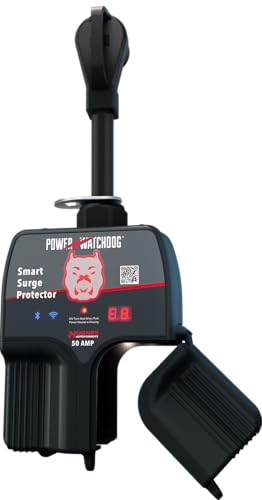
Power Watchdog PWD50W Smart, 50A
$249.99Adds WiFi and Bluetooth reporting of current on each leg separately, which is how you find out a 50 amp rig is unbalanced, with both air conditioners running off the same leg.
Best for: Diagnosing which leg is carrying the air conditioners.
Check price on Amazon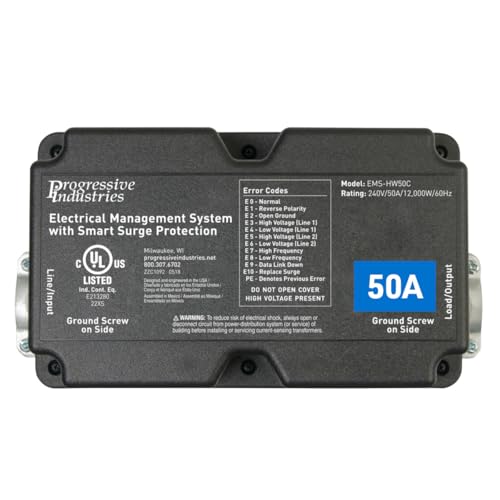
Progressive Industries EMS-HW50C Hardwired, 50A
$169.99A hardwired unit installed behind the distribution panel, which cannot be lifted off an unattended pedestal the way a portable unit can; skip this tier if you are not comfortable with a qualified installer wiring it in, since a plug-in EMS protects the same faults with none of the labor.
Best for: A permanent installation inside the rig.
Check price on AmazonFrequently asked questions
- What is the difference between 30 amp and 50 amp RV service?
- A 30 amp service is a single 120 volt leg rated at 30 amps, about 3,600 watts total. A 50 amp service is two separate 120 volt legs, each rated at 50 amps, for roughly 12,000 watts combined. That makes a 50 amp pedestal more than three times the capacity of a 30 amp one, not just a modest step up, which is why 50 amp rigs can run two air conditioners at once without careful load management.
- Can a 50 amp EMS protect a rig plugged in through a 30 amp adapter?
- No, not correctly. Once a 50 amp rig is stepped down through a dogbone adapter to a 30 amp pedestal, the coach only has 30 amps total available on a single leg, so it needs a 30 amp rated EMS on that connection, not a 50 amp unit. Keep both ratings on hand if you regularly move between 30 amp and 50 amp sites.
- Does a 50 amp EMS need to monitor both legs separately?
- Yes. A 50 amp service is two independent 120 volt legs, and a fault, such as low voltage or an open ground, can exist on one leg while the other reads perfectly normal. An EMS that only checks a single combined reading can miss a real problem entirely, which is why every unit on this page monitors each leg on its own.
- Is a hardwired EMS better than a portable one?
- Neither is electrically better; both catch the same four fault conditions. A hardwired unit is installed behind the panel and cannot be stolen off the pedestal, while a portable unit needs no installation and can move between rigs. Choose hardwired if the coach sits unattended often, and portable if simplicity and no wiring work matter more.
- Will an EMS shut off power to the whole coach during a fault?
- Yes, that is the intended behavior. When an EMS detects a fault outside its safe range, it disconnects the entire coach from shore power rather than letting a damaged pedestal keep feeding it. That means no air conditioning until the fault clears, which is a far better outcome than a fried converter board or compressor.
- Do I need a transfer switch in addition to an EMS?
- They solve different problems. An EMS protects against a bad pedestal connection. A transfer switch makes shore power and an onboard generator mutually exclusive so the two can never be connected at the same time, which protects both the coach's wiring and utility line crews from an accidental back-feed. A coach with both a generator and shore power should have both devices.
Match the EMS rating to the pedestal you are actually plugged into. A 50 amp EMS belongs on a true 50 amp connection; step down through an adapter and the correct move is a 30 amp rated unit, not the 50 amp one you already own.