Generators
What Size Generator to Run A coffee maker and a toaster?
Researched from published standards and manufacturer specifications. Updated .
Quick answer
Generators are sized by the startup surge, not by the running load, and this is where most undersized purchases come from. A 13,500 BTU air conditioner runs on about 1,400 watts, so a 2,000 watt generator looks like plenty. It is not, because the compressor needs roughly 3,000 watts for the fraction of a second it takes to get turning.
This load is largely resistive, so the running figure and the starting figure are close together and a soft starter would not help. Work through your own combination on the generator size calculator.
How many watts to run a coffee maker and a toaster?
| Configuration | Running watts | Starting watts | Generator to buy |
|---|---|---|---|
| As is | 2,100 W | 2,100 W | 2,200 W |
| With a soft starter | 2,100 W | 2,100 W | 2,200 W |
Convention Source: Typical published running and locked rotor figures for this equipment class. Your unit publishes its own data plate figures..
Is a soft starter cheaper than a bigger generator?
Not in this case. This load does not have enough motor surge for a soft starter to change the generator size you need.
The second benefit is weight. Generator weight rises steeply with output, and a generator too heavy to move alone is a generator that stays in the garage.
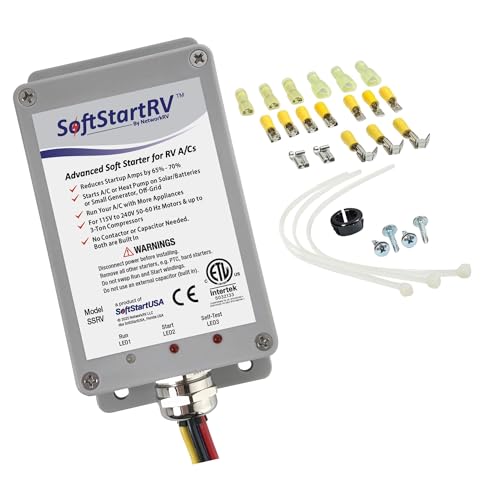
SoftStartRV Soft Start Kit
$295.00A soft starter cuts the compressor inrush, which is what lets a rooftop air conditioner start on a smaller generator or on an inverter.
Best for: Running air conditioning on a 2000W class generator.
Check price on Amazon
Spartan Power SpartanStart Soft Start Kit
$189.00Rated to 20,000 BTU, which covers the common 13,500 and 15,000 BTU rooftop units.
Best for: A standard rooftop unit up to 20,000 BTU.
Check price on AmazonDoes it need to be an inverter generator?
For an RV, yes, for two reasons. Inverter generators produce clean, stable output that is safe for electronics, chargers and variable speed motors, where a conventional generator's output can be rough enough to cause problems. They are also dramatically quieter and throttle down when the load is light, which matters in a campground with neighbours and quiet hours.
Look for a TT-30R outlet if you have a 30 amp rig, which lets you plug in without an adapter. And insist on a carbon monoxide shutoff sensor: it is the single most important safety feature on a generator used anywhere near where people sleep.
Could a battery and inverter do this instead?
At 2,100 watts running, this load pulls about 205.9 amps from a 12 volt bank, which is a great deal of current and a very large bank. A generator is the more practical answer for a load this size unless the system is built at 24 or 48 volts.
Size the alternative on the inverter sizing calculator and the battery bank calculator.
Generators that start a coffee maker and a toaster

WEN 56477i 4800W RV-Ready Inverter Generator
$634.99RV-ready means it carries a TT-30R outlet, so a 30A rig plugs in without an adapter. Inverter output is also clean enough for electronics.
Best for: A 30A rig that needs to run one air conditioner off grid.
Check price on Amazon
WEN 6800W Dual Fuel RV-Ready Inverter Generator
$798.00Dual fuel plus a CO shutoff sensor. Carbon monoxide detection is the feature to insist on with any generator used near a rig.
Best for: A large rig or two air conditioners.
Check price on Amazon
ERAYAK 4500W Dual Fuel RV-Ready Inverter Generator
$559.00A 30A RV outlet and dual fuel operation, so it can run on propane you already carry for the furnace.
Best for: Running on the propane already onboard.
Check price on Amazon
Pulsar PGD40ISCO 4000W Inverter Generator
$450.07Light enough for one person to move, which decides whether a generator gets used or stays in the garage.
Best for: Occasional use where weight matters most.
Check price on AmazonFrequently asked questions
- What size generator do I need to run a coffee maker and a toaster?
- About 2,200 starting watts. The load runs on roughly 2,100 watts but needs around 2,100 watts to start, and the starting figure is what sizes the generator. A unit rated only for the running load will stall or shut down trying to start it.
- Will a 2,000 watt generator run a coffee maker and a toaster?
- No, not as it stands. This load needs about 2,100 watts including startup, which is beyond a 2,000 watt generator. Even with a soft starter it needs about 2,100 watts, so a larger generator is required.
- Can I run two small generators in parallel instead?
- Yes, and it is a common approach. Two matched inverter generators joined with a parallel kit combine their output, and each one alone is light enough to carry. It also means you can run just one for small loads, which saves fuel and noise. Both units must be compatible models and the parallel kit must be the one the manufacturer specifies.
- Where is it safe to run a generator?
- Outside, well away from the rig, with the exhaust pointed away from windows, vents, doors and neighbouring rigs. Never in a garage even with the door open, never under an awning against the rig, and never in a pass-through compartment. Carbon monoxide is odorless and kills quickly. Fit a working CO alarm inside the rig and choose a generator with a CO shutoff sensor.
Generator safety. A generator must never be run in an enclosed or partly enclosed space, including a garage with the door open, under an awning against the rig, or in a pass-through compartment. Carbon monoxide is odorless and it kills. Keep the exhaust pointed away from windows, vents and neighbours, fit a working CO alarm inside the rig, and never refuel a hot engine.