Guides
How to Store an RV Battery Through the Off Season
Researched from published standards and manufacturer specifications. Updated .
Quick answer
Lead-acid batteries, flooded and AGM, must be stored FULL and topped up periodically, because a discharged lead-acid battery sulfates and can also freeze at a much higher temperature than a fully charged one. LiFePO4 batteries prefer to be stored at a partial charge instead, and must not be CHARGED below freezing, though they can sit or discharge in cold temperatures without that restriction. Use a battery disconnect switch or remove the battery entirely for storage; a parasitic draw left connected will flatten a bank over a season regardless of chemistry.
Storing a battery through an off season is a different problem than routine maintenance, because nobody is there to notice a slow decline until the battery is opened up again in spring. The two chemistry families need close to opposite treatment: lead-acid wants to be left full, and lithium prefers not to sit full. Getting this backward is one of the more expensive mistakes an RV owner can make, because a ruined battery from a single bad winter often costs more than a season's worth of routine charging would have.
This guide covers storage state of charge by chemistry, the freezing risk that a discharged lead-acid battery specifically faces, and the parasitic draw problem that damages a stored battery of any chemistry the same way: slowly, and without anyone noticing until it is too late.
What actually happens to a battery left sitting all winter?
Every battery self-discharges slowly on its own even with nothing connected, and most RVs also have some parasitic draw from a propane detector, a clock, or a converter left connected, which pulls the state of charge down faster than self-discharge alone. On lead-acid, that falling state of charge causes sulfation, a buildup of lead sulfate crystals on the plates that reduces capacity, and it also raises the electrolyte's freezing point as the battery discharges. On LiFePO4, the concern is different: the battery management system will refuse to accept charge current below freezing, so a pack that arrives at spring already cold and needing a top-up may not take a charge until it warms up.
Why must lead-acid be stored full, not partial?
Two separate reasons point to the same answer. A lead-acid battery left at a low state of charge sulfates, which permanently reduces capacity the longer it sits that way. Separately, a fully charged lead-acid battery's electrolyte has a much lower freezing point than a discharged one's, so a full battery tolerates cold storage that would freeze and crack the case of the same battery sitting half-discharged. Both problems are solved the same way: keep the battery topped up through the storage period, either with a periodic maintenance charge or a smart charger left connected to a stable power source.
How much does state of charge actually change a lead-acid battery's freeze risk?
The relationship between a lead-acid battery's state of charge and its electrolyte's freezing point is widely documented in battery industry literature, though the exact freezing temperature varies by the specific electrolyte concentration in a given battery. These figures are the commonly cited range, not a guarantee for any specific model.
| State of charge | Approximate freezing point |
|---|---|
| 100% (fully charged) | Well below 0°F |
| 50% | Roughly 0°F to 10°F |
| Fully discharged | As high as the low to mid 20s°F |
Convention Source: Widely cited relationship between lead-acid state of charge and electrolyte specific gravity in battery industry references. Exact freezing points vary by electrolyte concentration and are not published per model in this catalog.. Treat these as approximate ranges for planning, not as a guaranteed freezing point for a specific battery.
Why does LiFePO4 prefer a partial charge for storage instead of full?
LiFePO4 does not sulfate and has essentially no freeze risk from being discharged the way lead-acid does, so the full-charge storage practice that protects lead-acid does not apply the same way. Manufacturers commonly recommend storing a lithium pack at a partial state of charge, often cited in a range below full but above empty, for extended idle periods, on the reasoning that sitting at either extreme for a long stretch is harder on the cells than resting somewhere in the middle. There is no single figure published as an industry standard here, so check your specific battery's manual for its recommended storage state of charge rather than assuming a fixed percentage applies to every LiFePO4 pack in this catalog.
Is charging LiFePO4 in a cold battery bay during a spring check-in a problem?
It can be, if the bay is still below freezing. A standard LiFePO4 battery management system will refuse charge current below freezing regardless of the charger connected to it, which protects the cells from the damage that charging in the cold causes. Discharging a LiFePO4 battery in cold weather is generally fine; the restriction is specifically on charging. If you plan to top off a stored lithium battery during a cold check-in, warm it to above freezing first, or use a self-heating pack, before connecting any charger. Our battery maintenance guide covers this same restriction in the context of routine charging, not just storage.
Storage practices compared by chemistry
These practices summarize widely followed storage guidance for each chemistry family.
| Practice | Flooded / AGM lead-acid | LiFePO4 |
|---|---|---|
| Storage state of charge | Full, topped up periodically | Partial, per manufacturer recommendation |
| Freeze risk when discharged | Real, freezing point rises as charge falls | Minimal from discharge itself |
| Charging below freezing | Generally tolerated | BMS will refuse to charge below freezing |
| Parasitic draw risk | Sulfation from slow discharge | BMS protects against deep over-discharge, but a flat pack still needs warming before it will accept charge |
Convention Source: Widely followed storage guidance by chemistry, drawn from manufacturer documentation for the battery products in this catalog..
Should I disconnect the battery or remove it entirely?
Either works, and the choice mostly comes down to how the RV is stored. A rated disconnect switch installed in the negative cable stops any parasitic draw the instant it is switched off, without removing the battery from the compartment, which is the simpler option for an RV stored on the property where you can check in periodically. Removing the battery entirely and storing it indoors at a stable, moderate temperature is more effective for a very cold climate or a long storage period with no planned check-ins, since it takes the battery out of an environment where temperature swings and any wiring fault elsewhere in the RV could still affect it. A disconnect switch also has the advantage of being a permanent part of the electrical system rather than a seasonal task, so once installed it is available every time the RV sits unused for more than a few days, not just during a dedicated winter layup, which makes it worth adding even for an owner who does not consider themselves to be doing formal winter storage at all.

Nilight 90015A Battery Master Disconnect Switch
$12.12A cheap way to get a real disconnect into a build, and any disconnect beats pulling a terminal with a wrench.
Best for: Winter storage isolation.
Check price on AmazonDoes it matter whether the RV itself is stored indoors, outdoors, or with insulation?
It affects how much attention the battery needs, even though the storage practices themselves stay the same. An RV stored indoors or in a climate-controlled space holds a more stable temperature, which reduces how far a lead-acid battery's freeze risk can escalate even if its state of charge drops somewhat between check-ins, and it also means a LiFePO4 pack is less likely to be sitting below freezing if you need to top it off mid-season. An RV stored outdoors in a genuinely cold climate needs more frequent attention to keep a lead-acid battery topped up, since ambient temperature swings work against you, and a stored LiFePO4 pack is more likely to need warming before it will accept a check-in charge. Skirting or insulating the battery compartment specifically, separate from insulating the whole RV, is a middle option some owners use to buy some thermal buffer without a full climate-controlled storage space. None of this changes the underlying chemistry rules above, full charge and topped up for lead-acid, partial charge for LiFePO4, and no charging below freezing for either the battery or, more specifically, the lithium pack; it only changes how much margin you have before those rules become urgent. A battery compartment built into the underside of the RV, exposed to wind chill from underneath, generally runs colder than one built into an enclosed, heated basement compartment on a higher-end coach, which is worth factoring in when deciding how often a genuinely cold-climate rig needs a check-in over a long storage season.
Never charge a LiFePO4 battery that is still below freezing. Warm it above freezing first, whether that means bringing it indoors or waiting for ambient temperature to rise, before connecting any charger. A standard BMS will refuse the charge current outright, but forcing current in around that protection, or relying on a BMS that does not actually enforce the cutoff, risks permanent cell damage.
What to have on hand for winter storage
A disconnect switch stops the slow drain that ruins more stored batteries than cold ever does. A small charger and a way to check state of charge round out an occasional check-in without needing to pull the battery all the way indoors.
Nilight 90015A Battery Master Disconnect Switch
$12.12A low-cost disconnect switch built specifically for isolating a battery during storage, which stops any parasitic draw the moment it is switched off.
Best for: Winter storage isolation.
Check price on Amazon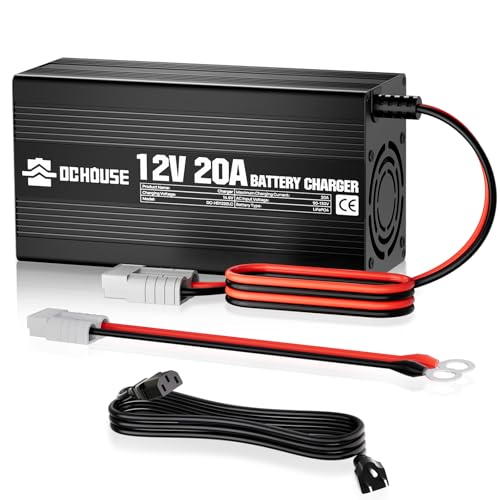
DC HOUSE 12V 20A Lithium Charger
$67.99A dedicated lithium charge profile for periodic top-ups on a battery pulled and stored off the rig over the season.
Best for: A battery stored off the rig over winter.
Check price on Amazon
AILI TR16 Shunt Battery Monitor
$42.00A shunt-based monitor lets you check actual state of charge during an occasional storage check-in, rather than guessing from voltage alone.
Best for: A first real state of charge readout.
Check price on AmazonFrequently asked questions
- Can I leave my RV plugged into shore power all winter instead of managing storage charge manually?
- For a lead-acid battery, yes, as long as the converter maintains a proper float charge without overcharging, which keeps the battery full through the season automatically. For a LiFePO4 battery, check that the converter or charger applies a lithium profile and does not hold the battery at 100 percent indefinitely, since manufacturers commonly prefer a partial charge for extended idle storage rather than a continuous full charge.
- Why does a discharged lead-acid battery freeze more easily than a full one?
- A lead-acid battery's electrolyte is a mix of sulfuric acid and water, and the freezing point of that mixture rises as the battery discharges and the acid concentration drops. A fully charged battery's electrolyte freezes at a much lower temperature than a discharged one's, which is why keeping the battery topped up through winter storage protects it from freeze damage as well as from sulfation.
- What percentage should I store a LiFePO4 battery at?
- There is no single industry-standard figure; manufacturers commonly recommend a partial state of charge for extended storage rather than full or empty, but the exact percentage varies. Check your specific battery's documentation for its recommended storage state of charge rather than assuming a fixed number applies across every LiFePO4 pack.
- Is it safe to discharge a LiFePO4 battery in freezing temperatures?
- Generally yes. The charging restriction below freezing is specific to accepting charge current, which a standard battery management system will refuse. Discharging the battery, meaning drawing power from it, is generally tolerated in cold temperatures, though available capacity can be reduced in very cold conditions regardless of chemistry.
- How much does a parasitic draw actually matter over a whole season?
- It can matter a great deal. A small continuous draw from a propane detector, a clock, or a converter left connected adds up over weeks and months of storage, and it is the reason a battery that seemed fine when parked can be deeply discharged months later. A disconnect switch or removing the battery entirely eliminates this risk regardless of how small any individual draw seems.
- Do I need to remove the battery for storage, or is a disconnect switch enough?
- A disconnect switch is generally enough for moderate climates or shorter storage periods with occasional check-ins, since it stops parasitic draw without the hassle of removal. For very cold climates or long periods with no check-ins planned, removing the battery and storing it indoors at a stable temperature is the more thorough option.
Lead-acid wants to be full; lithium does not. Store a flooded or AGM battery topped up and check it periodically through the season. Store a LiFePO4 battery at the partial charge your manufacturer recommends, and never charge it while it is still below freezing. Either way, a disconnect switch or removal stops the parasitic draw that ruins a battery no chemistry rule can protect against.