Inverters
What Size Inverter for a Roof vent fan?
Researched from published standards and manufacturer specifications. Updated .
Quick answer
Two numbers size an inverter, and only one of them is on the appliance label. The running figure decides the continuous rating. The startup surge decides whether the inverter will actually bring the appliance to life rather than shutting down trying.
The DC current figure is the one that most often gets skipped, and it is the number that decides your cable size, your fuse and whether your battery BMS can even supply the load. Work through your own combination with the inverter sizing calculator.
How many watts does a roof vent fan use?
| Figure | Value | What it decides |
|---|---|---|
| Running power | 30 W | Inverter continuous rating |
| Startup surge | 45 W | Inverter surge rating |
| Inverter continuous needed | 36 W | Includes headroom above the running load |
| Inverter surge needed | 45 W | Must cover the startup spike |
| Recommended inverter | 300 W | The size to buy |
Convention Source: Typical published draw for this appliance class. Read the data plate on your own unit..
How much current does this pull from the battery?
This is where 12 volt systems get expensive. Power is the same on either side of the inverter, so a load that is a modest number of AC amps becomes a large number of DC amps.
| System voltage | DC current while running | Minimum BMS rating | Cable for a 5 ft run |
|---|---|---|---|
| 12V | 2.9 A | 25 A | 14 AWG |
| 24V | 1.5 A | 25 A | 14 AWG |
Published standard Source: Conductor sizes from ABYC E-11 ampacity with a 3 percent voltage drop limit. Inverter efficiency of 85 percent is included in the current figures. Cable sizes assume a 5 foot one-way run, which is why an inverter belongs close to the bank.
Does this appliance need pure sine output?
Pure sine is what modern electronics, induction motors and anything with a microprocessor expect. Modified sine output can make motors run hot, cause audible buzzing, and outright damage some devices. Even on a resistive load like this one, pure sine costs little more and removes the question entirely. Every inverter recommended on this site is pure sine.
What does running this cost in battery capacity?
Running a roof vent fan for one hour uses about 3Ah from a 12 volt bank once inverter losses are counted. On a 100Ah LiFePO4 battery planned to 80 percent depth of discharge, that is roughly 27.2 hours of run time from a full battery. Check other combinations with the run time calculator.
Inverters that suit a roof vent fan

Renogy P2 1000W Pure Sine Inverter
$175.99Pure sine output is what induction motors and modern electronics expect, and Renogy publishes its efficiency and idle draw.
Best for: Running a residential fridge or a microwave on a modest bank.
Check price on Amazon
BELTTT 1000W Pure Sine Inverter
$107.99A published 2000W surge rating, which is the number that decides whether a motor will actually start.
Best for: Tools and small motor loads.
Check price on Amazon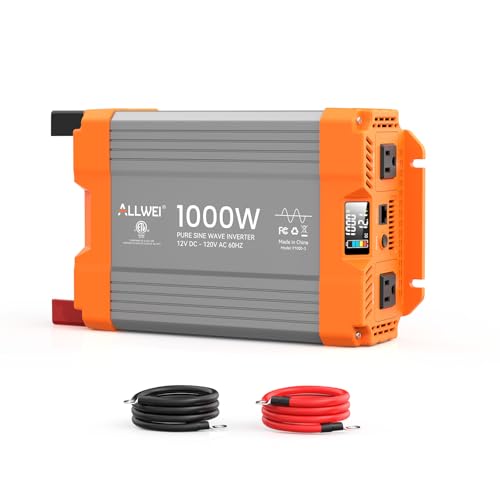
ALLWEI 1000W Pure Sine Inverter, ETL Listed
$89.97ETL listed to UL 458, which is the marine and mobile inverter standard and is worth looking for on a cheap unit.
Best for: A budget inverter with a real listing behind it.
Check price on AmazonFrequently asked questions
- What size inverter do I need for a roof vent fan?
- About 300 watts continuous. The appliance draws roughly 30 watts running, and the inverter needs headroom above that plus enough surge rating to cover the 45 watt startup. Sizing an inverter exactly at the running load leaves nothing for the startup spike and causes nuisance shutdowns.
- How many amps does a roof vent fan draw from a 12 volt battery?
- About 2.9 amps while running, once inverter efficiency of around 85 percent is included. That is the figure that decides cable size, fuse size and whether the battery BMS can supply the load. At 24 volts the same appliance pulls about 1.5 amps, which is why larger systems move to higher voltage.
- Can I run a roof vent fan on solar?
- Solar charges the battery, and the battery runs the appliance, so the question is whether your array replaces what the appliance takes out. One hour of use costs about 3 amp-hours. Replacing that needs roughly 12 watts of panel per hour of daily use at four peak sun hours.
- Why is the inverter rating higher than the appliance rating?
- Because an inverter running continuously at its maximum rating runs hot and its lifespan suffers, and because the startup surge of a motor load is far above its running draw. Headroom above the running load is what keeps the inverter cool, and the surge rating is what gets the appliance started in the first place.
Wiring safety. Never exceed a conductor's rated ampacity, and always fuse a circuit at or below what the wire can carry, because the fuse protects the wire rather than the appliance. Fuse every positive conductor as close to the battery as practical. Use proper crimped lugs and heat shrink rather than twisted joints, support cable so it cannot chafe through on a frame edge, and keep the battery compartment ventilated. Permanent AC wiring is work for a qualified RV technician or a licensed electrician.