Reference
RV Appliance Power Draw Chart: Running and Startup Watts
Researched from published standards and manufacturer specifications. Updated .
Quick answer
Running watts is the steady draw once an appliance is operating; startup watts is the brief surge a motor pulls when it switches on, and it is startup watts that sizes an inverter or generator, not running watts. A 13,500 BTU RV air conditioner runs at about 1,400 watts but surges to about 3,000 watts on startup, nearly double its running draw, which is why an inverter rated only for the running number will shut down or fail the moment the compressor kicks on.
Two numbers matter for every appliance in an RV: what it draws once it is running, and what it briefly pulls the instant a motor or compressor starts. Sizing an inverter, generator or shore power budget off the running number alone is the single most common way to undersize a system that then trips or shuts down the moment the air conditioner or refrigerator compressor kicks on.
This chart lists both numbers for every common RV appliance, then converts them to amps at 12V for DC loads and at 120V for AC loads, so the same chart answers a wattage question and an amperage question without a second lookup.
What is the difference between running watts and startup watts?
Running watts is the steady power an appliance draws once it has already started and is operating normally. Startup watts, sometimes called surge or locked-rotor watts, is the brief spike a motor or compressor pulls in the fraction of a second it takes to overcome its own inertia and reach running speed. That spike can be two to three times the running draw on a compressor-driven appliance, and it lasts well under a second, but an inverter or generator that cannot supply it for that instant will trip a protection circuit or stall rather than start the appliance at all.
RV appliance running and startup watts, full chart
These are typical published draw ranges compiled per appliance category, not a reading from a specific make and model. Always confirm against the nameplate or spec sheet on your own unit before finalizing a build; capacity, refrigerant type and motor design shift these numbers meaningfully between brands.
| Appliance | Running watts | Startup watts | Note |
|---|---|---|---|
| RV air conditioner, 13,500 BTU | 1400 | 3000 | Startup surge is what a generator or inverter must survive. |
| RV air conditioner, 15,000 BTU | 1700 | 3500 | A soft starter cuts the startup draw substantially. |
| Residential refrigerator | 150 | 800 | Duty cycles, so daily energy is far below running watts times 24. |
| 12V compressor refrigerator | 45 | 120 | Runs straight off the bank with no inverter. |
| Microwave, 1000W output | 1500 | 1500 | Input watts are well above the cooking power rating on the door. |
| Electric kettle | 1500 | 1500 | A short, very heavy load. |
| Coffee maker, drip | 900 | 900 | No additional note. |
| Toaster | 1200 | 1200 | No additional note. |
| Induction cooktop, single burner | 1800 | 1800 | Often the single largest load in a rig. |
| Space heater, low setting | 750 | 750 | Electric heat is the fastest way to trip a 30A pedestal. |
| Space heater, high setting | 1500 | 1500 | No additional note. |
| Hair dryer | 1500 | 1500 | No additional note. |
| Converter or charger, 55A | 750 | 750 | Charging the house bank is itself an AC load on the pedestal. |
| Water heater, electric element | 1440 | 1440 | Switch to propane to free up pedestal capacity. |
| Television, LED 32 inch | 50 | 60 | No additional note. |
| Laptop | 60 | 60 | No additional note. |
| CPAP, no humidifier | 40 | 40 | Humidifier and heated hose multiply this several times over. |
| CPAP with heated humidifier | 90 | 90 | No additional note. |
| LED interior lighting, whole rig | 30 | 30 | No additional note. |
| Furnace blower, 12V | 100 | 180 | The furnace burns propane but the blower runs off the battery. |
| Water pump, 12V | 60 | 110 | No additional note. |
| Roof vent fan | 30 | 45 | No additional note. |
| Electric tongue jack | 250 | 400 | Brief, but a real draw on a small bank. |
| Residential washer/dryer combo | 1200 | 2000 | Requires 50A service in practice. |
Convention Source: Typical manufacturer nameplate ranges compiled per appliance category; individual models vary, so confirm against the nameplate on your own unit..
12V DC appliances converted to amps
| Appliance | Running watts | Running amps at 12V | Startup amps at 12V |
|---|---|---|---|
| 12V compressor refrigerator | 45 | 3.8 | 10.0 |
| LED interior lighting, whole rig | 30 | 2.5 | 2.5 |
| Furnace blower, 12V | 100 | 8.3 | 15.0 |
| Water pump, 12V | 60 | 5.0 | 9.2 |
| Roof vent fan | 30 | 2.5 | 3.8 |
| Electric tongue jack | 250 | 20.8 | 33.3 |
Published standard Source: Ohm's law conversion, amps equals watts divided by volts, applied to the running and startup watts in the chart above. This is the amp draw a fuse, wire gauge or shunt reading should be checked against for a circuit fed directly from the 12V house bank.
120V AC appliances converted to amps at the pedestal
| Appliance | Running watts | Running amps at 120V | Startup amps at 120V |
|---|---|---|---|
| RV air conditioner, 13,500 BTU | 1400 | 11.7 | 25.0 |
| RV air conditioner, 15,000 BTU | 1700 | 14.2 | 29.2 |
| Residential refrigerator | 150 | 1.3 | 6.7 |
| Microwave, 1000W output | 1500 | 12.5 | 12.5 |
| Electric kettle | 1500 | 12.5 | 12.5 |
| Coffee maker, drip | 900 | 7.5 | 7.5 |
| Toaster | 1200 | 10.0 | 10.0 |
| Induction cooktop, single burner | 1800 | 15.0 | 15.0 |
| Space heater, low setting | 750 | 6.3 | 6.3 |
| Space heater, high setting | 1500 | 12.5 | 12.5 |
| Hair dryer | 1500 | 12.5 | 12.5 |
| Converter or charger, 55A | 750 | 6.3 | 6.3 |
| Water heater, electric element | 1440 | 12.0 | 12.0 |
| Television, LED 32 inch | 50 | 0.4 | 0.5 |
| Laptop | 60 | 0.5 | 0.5 |
| CPAP, no humidifier | 40 | 0.3 | 0.3 |
| CPAP with heated humidifier | 90 | 0.8 | 0.8 |
| Residential washer/dryer combo | 1200 | 10.0 | 16.7 |
Published standard Source: Ohm's law conversion, amps equals watts divided by volts, applied to the running and startup watts in the chart above. A 30A pedestal supplies 3,600 VA at 120V; adding these amps across simultaneous loads is the fastest way to check whether a combination trips the breaker.
Building a simultaneous-use load list from this chart
The chart above only becomes useful once it is turned into a specific list of what runs at the same time in a specific rig. Start with whatever is always on, LED lighting, the 12V compressor refrigerator or the residential fridge's duty cycle average, and add the running watts of that baseline together first. Then layer in what typically runs alongside it: a coffee maker in the morning, a space heater overnight, the water pump during a shower. The single largest number to isolate separately is the startup watts of whichever motor-driven appliance is likely to start last, since that brief surge stacks on top of whatever baseline is already running rather than replacing it. A generator, inverter or shore power budget only needs to survive the worst realistic combination, not every appliance in the chart running at once.
Why a refrigerator on this chart looks bigger than it acts all day
A residential refrigerator listed at 150 running watts is not drawing 150 watts continuously for 24 hours. Compressor-driven refrigerators cycle on and off to maintain temperature, so the compressor might run roughly a third to half of any given hour depending on ambient temperature, door openings and how full the fridge is. Daily energy for sizing a battery bank should come from a duty-cycle estimate or a measured reading, not from multiplying the running watts figure straight through 24 hours, which overstates daily consumption by two to three times.
Size the inverter and generator to the startup column, not the running column. An inverter or generator that only covers running watts will fail to start a compressor-driven appliance at all, showing up as a nuisance shutdown the first time the air conditioner or refrigerator kicks on.
What to buy once you know your real draw
Buy inverter and generator capacity against the startup column, not the running column, and confirm the actual draw on your own nameplate before finalizing a build, since the figures below are typical published ranges, not a reading off your specific unit.
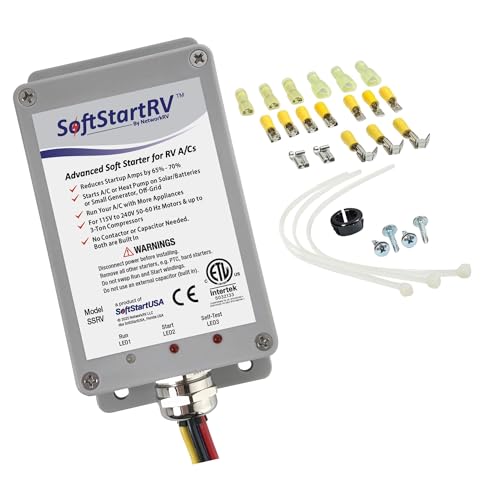
SoftStartRV Soft Start Kit
$295.00Targets the exact gap between running and startup watts this chart documents for both air conditioner entries.
Best for: Running air conditioning on a 2000W class generator.
Check price on Amazon
Renogy P2 2000W Pure Sine Inverter
$285.99Covers a residential refrigerator startup surge alongside a handful of the smaller entries on this chart at once.
Best for: A 200Ah lithium bank with a 200A BMS.
Check price on Amazon
Renogy P2 3000W Pure Sine Inverter
$414.99Headroom for microwave, induction cooktop or kettle entries running near simultaneously with other house loads.
Best for: A large lithium bank where air conditioning on inverter is the goal.
Check price on Amazon
Victron SmartShunt 500A Battery Monitor
Price varies, check the listingConfirms actual amp draw against this chart rather than trusting nameplate estimates alone, since real units vary from the published range.
Best for: Any lithium bank you plan to boondock on.
Check price on AmazonFrequently asked questions
- Why does an air conditioner need three times its running watts to start?
- The compressor motor has to overcome its own mechanical inertia and build up refrigerant pressure difference in the instant it switches on, which draws far more current than it needs once spinning at operating speed. A 13,500 BTU unit running at about 1,400 watts can surge to about 3,000 watts for a fraction of a second on startup, which is the number an inverter or generator has to survive, not the running figure.
- Does a soft starter change the running watts of an air conditioner?
- No, a soft starter only reduces the startup surge by ramping the compressor up more gradually instead of applying full line current instantly. The running watts once the compressor is up to speed stay the same as the unmodified unit. A soft starter is what lets a smaller inverter or generator, sized closer to the running figure, actually start the same air conditioner.
- Why is a refrigerator daily energy estimate not just running watts times 24 hours?
- Compressor-driven refrigerators cycle on and off to hold temperature rather than running continuously, so the compressor is typically active only a third to half of any given hour depending on ambient heat, door openings and how full the unit is. Multiplying the running watts figure by 24 hours overstates real daily energy use by two to three times.
- How do I convert an appliance watt rating into amps for my fuse or wire?
- Divide watts by the system voltage the appliance actually runs on: 12V for a DC appliance wired straight to the house bank, or 120V for an AC appliance run through an inverter or plugged into shore power. Use the startup watts for sizing an inverter or a motor-start-rated breaker, and the running watts for continuous load and daily energy calculations.
- Can I add up the amps of several appliances to check a 30A pedestal?
- Yes, that is the direct way to check it: sum the running amps of everything expected to run simultaneously and compare the total against 30A, since a 30A pedestal supplies a single 120V leg. Remember to add the startup amps of whichever single appliance is starting last, since that brief surge stacks on top of whatever is already running, not the running amps alone.
- Are the watt figures on this chart exact for my specific appliance?
- No, they are typical published ranges compiled per appliance category, not a reading from your specific make and model. Capacity, refrigerant type, motor design and even ambient temperature shift real numbers meaningfully. Always check the nameplate or spec sheet on your own unit before finalizing an inverter, generator or wire gauge choice built around these figures.
Size against startup watts, verify against running watts. Use the startup column to pick an inverter or generator that will actually start the appliance, then use the running column and a realistic duty cycle to budget daily energy for the battery bank. The two numbers answer two different questions, and a build that only checks one of them tends to fail on the other.