Reference
Battery Chemistry Comparison Chart: LiFePO4 vs AGM vs Flooded
Researched from published standards and manufacturer specifications. Updated .
Quick answer
LiFePO4 is planned around 80 percent usable depth of discharge, versus 50 percent for AGM and flooded lead-acid, both planning conventions rather than manufacturer specifications. That means a 100Ah LiFePO4 battery gives roughly 80Ah usable, while a 100Ah AGM or flooded battery gives roughly 50Ah usable, at roughly a third to a quarter the weight for the lithium pack. AGM and flooded share the same usable-capacity convention on this site since neither publishes a materially different single figure worth quoting apart.
LiFePO4, AGM and flooded lead-acid are the three battery chemistries an RV house bank is actually built from, and they differ on more than sticker price. Usable capacity per rated amp-hour, weight, how they behave under heavy current draw, and how their resting voltage relates to state of charge all vary by chemistry in ways that change what battery actually belongs in a given rig.
This chart compares the three head to head, then breaks out the Peukert effect, the capacity loss lead-acid suffers at high discharge rates, that LiFePO4 is close enough to avoid.
What actually differs between LiFePO4, AGM and flooded lead-acid?
LiFePO4, or lithium iron phosphate, stores more usable energy per pound and tolerates a deeper regular discharge without the same cycle-life penalty that lead-acid chemistries carry. AGM, absorbed glass mat, and flooded lead-acid are both lead-acid chemistries at the core, differing mainly in how the electrolyte is held, sealed and maintenance-free for AGM, liquid and requiring periodic water top-off for flooded, while sharing similar usable capacity, cycle life and Peukert behavior. The comparison that matters for sizing a bank is less AGM-versus-flooded and more lead-acid-versus-lithium.
Chemistry comparison, side by side
Usable depth of discharge figures below are industry planning conventions, not manufacturer specifications. Manufacturers publish cycle life against a discharge-depth curve rather than a single usable number; these are the widely used planning assumptions this site applies to every calculator.
| Factor | LiFePO4 | AGM | Flooded lead-acid |
|---|---|---|---|
| Usable capacity convention (100Ah rated) | ~80Ah (80% convention) | ~50Ah (50% convention) | ~50Ah (50% convention) |
| Typical cycle life at usable DoD | Several thousand cycles | Several hundred cycles | Several hundred cycles, often fewer than AGM |
| Maintenance | None | None | Periodic water top-off required |
| Mounting orientation | Any orientation | Any orientation | Upright only, vents gas |
| Charging below freezing | Needs BMS cutoff or self-heating cells | No special cutoff needed | No special cutoff needed |
| Peukert effect at high discharge rate | Close enough to none, generally ignored | Present, exponent roughly 1.1 to 1.3 | Present, exponent roughly 1.1 to 1.3 |
| Resting voltage curve shape | Flat through the middle, unreliable for state of charge alone | Steadily sloped, usable for state of charge by voltage | Steadily sloped, usable for state of charge by voltage |
| Typical weight, 100Ah class | ~22 to 26 lb | ~60 to 65 lb | ~60 to 70 lb |
Convention Source: Usable depth of discharge and Peukert exponents are this site’s planning conventions (80 percent LiFePO4, 50 percent lead-acid, Peukert 1.25 for lead-acid); maintenance, mounting and charging behavior are drawn from manufacturer chemistry specifications. AGM and flooded lead-acid share the same usable-capacity convention here because neither publishes a materially different single figure; individual manufacturer cycle life curves vary within each chemistry.
The planning figures behind this chart
| Figure | Value | Basis | Source |
|---|---|---|---|
| Usable depth of discharge, LiFePO4 | 80% | convention | Common planning figure; individual LiFePO4 manufacturers publish their own usable depth and cycle life |
| Usable depth of discharge, lead-acid (AGM and flooded) | 50% | convention | Widely repeated planning guideline, not a published specification, since manufacturers publish cycle life against a discharge-depth curve instead |
| Peukert exponent, lead-acid | 1.25 | standard | Peukert exponent, typically 1.1 to 1.3 for lead-acid, published per battery by some manufacturers |
Convention Source: This site's figure registry in src/lib/power.mjs; the Peukert exponent is closer to a manufacturer-published standard than the two depth of discharge conventions above it.
How the usable-capacity gap plays out over a weekend of boondocking
A 100Ah lead-acid battery at the 50 percent convention gives about 50Ah before it needs a recharge, while a 100Ah LiFePO4 battery at 80 percent gives about 80Ah, a 30Ah difference that compounds fast on a multi-day trip without shore power. A rig drawing a steady 15A overnight for a fridge, lighting and a CPAP runs the lead-acid battery down to its usable floor in a little over three hours, while the same draw on LiFePO4 stretches past five hours before hitting its own floor. Over a three night boondocking stretch, that gap is the difference between needing to run a generator or drive somewhere to recharge and simply making it to the next full-sun day on solar alone.
Why flooded and AGM share one usable-capacity number here
Flooded lead-acid can sometimes tolerate an occasional deeper discharge better than its cycle life curve suggests, but doing so still shortens total cycle life meaningfully, and no single widely agreed figure separates it from AGM cleanly enough to publish as a distinct planning number. Both chemistries are lead-acid at the core and both are planned around the same 50 percent usable convention on this site. A specific flooded or AGM battery's own manufacturer discharge-depth curve, when available, is more accurate than either generic convention.
The Peukert effect: why lead-acid delivers less at high current
Peukert’s exponent describes how a lead-acid battery loses effective capacity as the discharge rate rises above its rated test rate. LiFePO4 is close enough to an exponent of 1.0 that this site skips the correction for lithium entirely, while lead-acid uses 1.25 in every run time calculation. The gap between the two chemistries widens well past the raw usable-Ah difference alone as current increases.
| Draw (A) | LiFePO4 hours (80% usable, no Peukert) | Lead-acid hours (50% usable, Peukert 1.25) |
|---|---|---|
| 5 | 16 | 10 |
| 10 | 8 | 4.2 |
| 20 | 4 | 1.8 |
| 30 | 2.7 | 1.1 |
| 40 | 2 | 0.7 |
| 50 | 1.6 | 0.6 |
Convention Source: Computed with this site's usable depth of discharge conventions (80 percent LiFePO4, 50 percent lead-acid) and a Peukert exponent of 1.25 applied to lead-acid only. At 50A draw, LiFePO4 delivers more than two and a half times the run time of lead-acid on the same rated 100Ah, a wider gap than the 80-vs-50 usable-Ah difference alone would suggest, because Peukert reduces effective lead-acid capacity further as current rises.
Never charge a standard LiFePO4 battery below freezing unless its BMS has a verified low-temperature charge cutoff, or the pack is self-heating. Charging below freezing without that protection degrades the cells even on units where the BMS still lets current through.
Batteries by chemistry
Match the chemistry to how the bank actually gets discharged and recharged, not to the lowest sticker price. A bank that rarely gets drawn down far or often has little to gain from lithium cycle life; a boondocking bank that gets drawn down hard every night recovers the lithium price premium fastest.
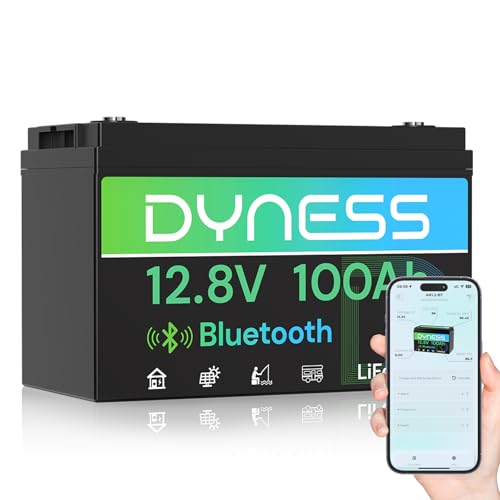
Dyness 12V 100Ah LiFePO4 with Bluetooth
$199.98Verifies actual state of charge against the flat-curve limitation this chart calls out for lithium.
Best for: Owners who want pack data without wiring a shunt on day one.
Check price on Amazon
VMAX SLR100 12V 100Ah AGM Deep Cycle
$269.96A true deep cycle AGM with no cranking rating on the label, the mark of a battery built for house-bank cycling rather than starting duty.
Best for: A lead-acid bank where lithium is out of budget.
Check price on Amazon
Renogy 12V 200Ah Deep Cycle AGM
$395.99Doubles AGM rated capacity to land near a lithium-sized usable bank where upfront cost matters more than weight.
Best for: A large lead-acid bank where weight is not a constraint.
Check price on Amazon
LiTime 12V 100Ah RV Self-Heating LiFePO4
$368.99Self-heating cells solve the freezing-temperature charge limitation covered below without a separate BMS cutoff to manage manually.
Best for: A documented build where the heating current has to be accounted for.
Check price on AmazonFrequently asked questions
- Why do AGM and flooded batteries get the same usable capacity figure on this site?
- Both are lead-acid chemistries at the core, differing mainly in electrolyte format rather than in the underlying usable-capacity behavior, and neither publishes a single widely agreed figure distinct enough from the other to warrant a separate planning convention. This site applies the same 50 percent usable depth of discharge convention to both, while noting that a specific battery’s own manufacturer discharge curve is more accurate than either generic figure.
- What is the Peukert effect and why does it only apply to lead-acid here?
- The Peukert effect describes how a battery loses effective capacity as discharge current rises above its rated test rate, and lead-acid batteries show this clearly, with a typical exponent between 1.1 and 1.3. LiFePO4 cells are close enough to an exponent of 1.0 that applying the correction would imply a precision the chemistry does not actually show, so this site applies Peukert only to lead-acid runtime calculations.
- Why is LiFePO4 resting voltage nearly useless for state of charge in the middle of the range?
- LiFePO4 holds a very flat voltage across roughly 20 to 90 percent state of charge, so a voltmeter reading in that range tells you almost nothing about how full the battery actually is. A shunt-based monitor that tracks amp-hours in and out, rather than voltage alone, is the accurate tool for LiFePO4, while AGM and flooded batteries have a steadier voltage slope that a simple voltmeter can read more usefully.
- Can a 200Ah AGM bank match a 100Ah LiFePO4 bank?
- On usable capacity, yes, roughly: a 200Ah AGM bank at the 50 percent convention gives about 100Ah usable, similar to a 100Ah LiFePO4 battery at the 80 percent convention. It will weigh well over a hundred pounds more and hold far fewer total cycles before needing replacement, and it still carries the Peukert penalty at high discharge rates that lithium avoids.
- Does LiFePO4 need a different charge profile than lead-acid?
- Yes, every charging source that touches a LiFePO4 bank, including the converter, the solar charge controller and any DC-DC charger, needs a genuine lithium charge profile rather than a lead-acid default. A lead-acid profile will undercharge a lithium bank and never bring it to full capacity, and it may not protect it correctly during charging.
- Which chemistry actually needs maintenance?
- Flooded lead-acid is the only one of the three that needs periodic maintenance, specifically topping off electrolyte water as it is consumed during charging cycles. AGM and LiFePO4 are both sealed and maintenance-free in normal use, though LiFePO4 still needs its BMS and charge sources checked for a correct lithium profile, which is a setup task rather than ongoing maintenance.
Usable capacity, not rated capacity, is the number to compare. A 100Ah rating means very different real-world amp-hours depending on chemistry, and depth of discharge is always a planning convention rather than a specification. Check a battery's own manufacturer discharge curve when one is published, and use the conventions on this chart only when it is not.