Reference
Peak Sun Hours by US Region and Season Chart
Researched from published standards and manufacturer specifications. Updated .
Quick answer
A peak sun hour equals one hour of sunlight at 1,000 watts per square meter, the standard used to rate a solar panel. It is not daylight hours: a nine hour winter day in the Pacific Northwest can hold as little as 1.4 peak sun hours, versus 4.5 in the Desert Southwest the same season. Because array sizing formulas divide by this number, using daylight hours instead of true peak sun hours understates the array needed by two to three times in winter across the northern half of the country.
Peak sun hours is the figure that turns a daily watt-hour budget into an array size, and it is the step most first-time solar buyers get wrong by substituting daylight hours for it. A cloudy nine hour winter day is not nine peak sun hours; it might be two.
This page gives winter, summer and annual peak sun hour figures for ten US regions, then shows what array wattage those figures actually demand for a couple of common daily energy budgets, so the region a rig spends winters in becomes a real number instead of a guess.
What counts as a peak sun hour, exactly?
One peak sun hour is the energy delivered by one hour of sunlight at a standardized intensity of 1,000 watts per square meter, the same reference intensity a solar panel is rated against on its nameplate. A location does not receive a steady 1,000 W/m2 all day; it ramps up from sunrise, peaks near midday, and tapers toward sunset, plus loses more to cloud, haze and low sun angle in winter. Adding up all of that variable intensity across a real day and expressing it as a number of hours at the reference intensity is what a peak sun hour figure represents, and it is always lower than the number of daylight hours in the same day.
Peak sun hours by US region, winter vs summer vs annual
These are rounded regional planning figures, not a single city forecast. A specific location within a region can run somewhat higher or lower depending on elevation, typical cloud cover and local terrain shading.
| Region | Winter | Summer | Annual average |
|---|---|---|---|
| Desert Southwest | 4.5 | 7.0 | 5.8 |
| Southern California | 4.0 | 6.5 | 5.4 |
| Mountain West | 3.2 | 6.5 | 5.0 |
| Texas and Gulf Coast | 3.4 | 5.8 | 4.7 |
| Florida and Southeast | 3.8 | 5.5 | 4.8 |
| Midwest | 2.4 | 5.6 | 4.1 |
| Mid-Atlantic | 2.6 | 5.4 | 4.2 |
| New England | 2.2 | 5.2 | 3.9 |
| Pacific Northwest | 1.4 | 5.5 | 3.6 |
| Northern Plains | 2.6 | 5.9 | 4.3 |
Published standard Source: NREL insolation data, regional figures rounded for planning. Winter is the figure to design a boondocking array against. Summer overproduction just gets clipped by the charge controller once the battery reaches full.
Array watts needed for a daily energy budget, by region
Array watts equals daily watt-hours divided by peak sun hours, divided again by a system derate. The derate below, 0.75, is a planning convention covering panel temperature, soiling, wiring loss, controller efficiency and imperfect aim, not a specification. A flat RV roof cannot tilt toward the sun the way a ground-mounted panel can, so the low end of the commonly cited derate range is the honest planning figure for a roof array. These examples use each region's winter figure, since winter is the case a boondocking bank has to survive.
| Region | Winter peak sun hours | Array watts for 500Wh/day | Array watts for 1000Wh/day |
|---|---|---|---|
| Desert Southwest | 4.5 | 148 | 296 |
| Southern California | 4.0 | 167 | 333 |
| Mountain West | 3.2 | 208 | 417 |
| Texas and Gulf Coast | 3.4 | 196 | 392 |
| Florida and Southeast | 3.8 | 175 | 351 |
| Midwest | 2.4 | 278 | 556 |
| Mid-Atlantic | 2.6 | 256 | 513 |
| New England | 2.2 | 303 | 606 |
| Pacific Northwest | 1.4 | 476 | 952 |
| Northern Plains | 2.6 | 256 | 513 |
Convention Source: Peak sun hours from NREL insolation data; array watts computed as daily Wh divided by sun hours divided by a 0.75 system derate convention for temperature, soiling, wiring and controller losses. The Pacific Northwest needing more than three times the Desert Southwest array for the same daily budget is the practical reason regional sun hours matter more than a single nationwide rule of thumb.
Which sun-hour figure to design around, by camping style
| Camping style | Design around | Why |
|---|---|---|
| Boondocking, self-sufficient for days at a time | Winter figure for the region | A short, cloudy winter day is the case the bank has to survive without a pedestal to fall back on. |
| Seasonal or three-season camping | Annual average | Balances panel cost against a shoulder-season sun-hour figure that is neither the best nor the worst case. |
| Warm-season-only camping, rig stored otherwise | Summer figure for the region | The winter number never applies if the rig sits in storage the rest of the year. |
| Frequent shore power hookups | Any figure; treat solar as supplemental | The pedestal, not the sun, is covering most of the daily deficit, so undersizing the array costs little. |
Convention Source: Planning guidance based on how the sun-hours figure feeds this site's solar sizing calculators, not a published specification.
Roof-mounted vs portable panels, and what changes by region
In a region with strong winter sun hours, like the Desert Southwest at 4.5, a fixed roof-mounted array performs close to what the table above predicts most days. In a region with weak winter sun hours, like the Pacific Northwest at 1.4 or New England at 2.2, a portable panel that can be angled toward a low winter sun and moved into a clearing away from tree shade routinely outperforms a flat roof panel receiving that same regional number, because the regional figure assumes reasonably unobstructed exposure that a shaded campsite often does not provide.

Link Solar Weatherproof Double Entry Gland
$9.89A low, rounded profile that sheds water rather than damming it behind the box.
Best for: A tidy roof entry on a flat roof.
Check price on Amazon
Renogy 30A PWM Controller with LCD
$61.99A flush-mount body with a readable display, which makes it practical to mount inside where you will actually look at it.
Best for: A visible panel-mount installation.
Check price on AmazonDoes cloud cover already get baked into these numbers?
Yes. Peak sun hour figures are derived from long-term measured insolation data for a region, which already averages in the typical mix of clear, hazy and cloudy days across that season. A single unusually overcast week can still underperform the table, and a run of clear days can outperform it, but the regional number represents a realistic seasonal average rather than a best-case clear-sky estimate.
Panels worth stacking where sun hours run low
A region with 1.4 winter peak sun hours does not need a better panel, it needs more panel area or the ability to angle toward the sun, since a fixed flat roof panel can never correct for a low sun angle. Portable panels answer that by moving into a clear, angled spot; roof panels answer it by adding more of them.
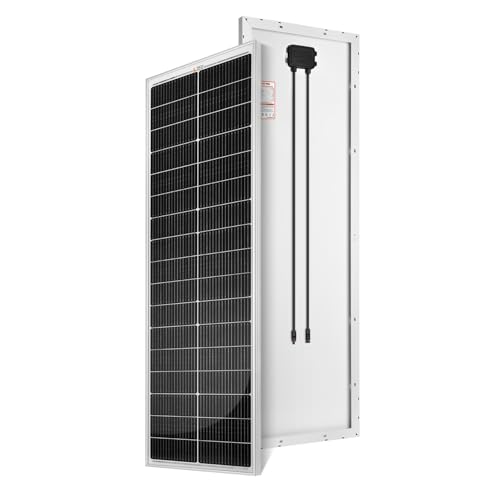
Rich Solar MEGA 100 Slim Panel
$119.99Low profile design lets several go on one roof without the bulk of a standard frame, useful in the low-sun-hour regions on this chart.
Best for: Roofs where the limit is width, not budget.
Check price on Amazon
Renogy 100W Monocrystalline Panel
$94.9516 busbar cell design pulls more watts out of the same panel footprint, which matters most where winter peak sun hours run under 3.
Best for: A first panel on a small trailer.
Check price on Amazon
DOKIO 200W Foldable Solar Suitcase
$109.99A foldable 200W suitcase panel that can be angled toward the sun and moved out of tree shade, both of which raise effective sun hours above what a fixed roof panel sees.
Best for: Occasional boondocking on a budget.
Check price on Amazon
ACOPOWER 200W Portable Solar Kit
$278.50Lower cost entry into a movable 200W array for a region where roof space or shading limits fixed panels.
Best for: Adding capacity without drilling.
Check price on Amazon
BougeRV 200W Foldable Solar Panel
$199.99Built-in angle adjustment for aiming closer to the sun angle a specific region and season actually delivers.
Best for: Anyone who will actually carry the panel out each morning.
Check price on AmazonFrequently asked questions
- Is peak sun hours the same as daylight hours?
- No, and treating them as the same is the most common solar sizing mistake. Daylight hours count sunrise to sunset regardless of intensity. Peak sun hours convert the day's total variable sunlight into an equivalent number of hours at a standardized 1,000 W/m2 intensity, which is always fewer than the daylight hours in the same day, often by half or more in winter.
- Which season should I design my solar array around?
- Winter, if the rig needs to be self-sufficient for days at a time year round, since winter peak sun hours are the lowest figure a boondocking bank has to survive. Design around the annual average instead for seasonal or three-season use, or the summer figure for a rig that is stored during the cold months and never has to cover a winter deficit.
- Why do two regions with similar daylight length have very different peak sun hours?
- Daylight length depends on latitude and time of year alone. Peak sun hours also depend on typical cloud cover, haze, elevation and sun angle intensity, all of which vary regionally in ways daylight length does not capture. The Pacific Northwest and the Midwest can have comparable winter daylight hours yet very different peak sun hour figures because of typical winter cloud cover.
- Does the array watts formula already include system losses?
- Only if a derate factor is applied, which is a separate planning convention, not part of the peak sun hours figure itself. The formula is daily watt-hours divided by peak sun hours divided by a derate, commonly 0.75, that accounts for panel heat, soiling, wiring resistance and controller efficiency. Skipping the derate understates the array needed by roughly 25 percent.
- Should I use the winter or annual figure if I only camp part of the year?
- Use the figure for whichever season the rig is actually in use during. A rig stored through winter and used only in summer should size against the summer figure, since the winter deficit never has to be covered. A rig used year round, including winter trips, should size against the winter figure even though it produces a larger, more conservative array.
- Do portable panels get more effective sun hours than a roof-mounted panel in the same region?
- They can, because a portable panel can be angled toward the sun and relocated away from tree or terrain shading, both of which a flat, fixed roof panel cannot do. The regional peak sun hour figures in this chart assume reasonably unobstructed exposure; a shaded campsite can push a roof panel below the regional number while a repositioned portable panel stays closer to it.
Use the winter number if in doubt. A boondocking solar array sized against a regional winter peak sun hour figure will overproduce most of the rest of the year. One sized against the annual average will fall short on the shortest, cloudiest days, which is exactly when the battery needs it most.