Reviews
PowerMax PM3-55LK Review: The Converter Swap a Lithium Conversion Forgets
Researched from published standards and manufacturer specifications. Updated .
Quick answer
Most RVs ship with a converter built to charge lead-acid or AGM batteries, and that converter is usually the last thing an owner thinks to check when planning a lithium conversion, after the battery, the solar controller and the inverter are already picked out. That is a mistake. A converter running a fixed lead-acid charge curve will charge a LiFePO4 bank to a partial state and stop there every time the rig sits on shore power, because the lead-acid absorption and float voltages it applies are lower than what lithium needs to reach a genuine full charge.
The PowerMax PM3-55LK exists specifically to close that gap. It is a 55A deck-mount converter built around a lithium-appropriate charge profile from the factory, rather than a lead-acid unit relabeled for lithium compatibility without the voltages actually changing.
Does a lithium battery really need its own converter?
Yes, in almost every case. A LiFePO4 battery needs a higher absorption voltage than lead-acid to reach full charge, and it does not need the trickle float stage a lead-acid battery uses for long-term maintenance, since a lithium BMS handles cell balancing differently. A converter stuck on a lead-acid profile will apply voltages too low for lithium's absorption stage, so the bank appears to charge but never reaches a true 100 percent, and it will also apply a float voltage that a lithium BMS may interpret differently than intended. This is the single most common oversight in a do-it-yourself lithium conversion: the battery gets swapped, and the box that charges it from shore power does not.
PowerMax PM3-55LK vs the other converters in this catalog
The comparison below uses each manufacturer's published specifications and current catalog pricing.
| Converter | Lithium profile | Mount | Listed price |
|---|---|---|---|
| PowerMax PM3-55LK | Yes, dedicated lithium mode | Deck mount | $133.00 |
| PowerMax PM4-55A | Yes, selectable output voltage | Deck mount | $143.00 |
| WFCO WF-9855-AD-CB | Yes, auto-detect lead-acid or lithium | Deck mount | $248.99 |
| VEVOR 55A Converter | Compatible, 4-stage charging | Not specified | $64.84 |
Published standard Source: Manufacturer-published specifications and current catalog listings in this repository.. Whether a listed lithium profile is fixed, selectable or auto-detected varies by model; check the specific converter documentation against your battery manufacturer's recommended voltages before relying on any preset.
Who should not buy it?
Anyone whose rig is staying on lead-acid or AGM, with no plan to convert to lithium, does not need this converter. The stock converter that already works fine on lead-acid should stay in place; swapping to a lithium-specific unit brings no benefit to a lead-acid bank and simply spends money on a feature that goes unused. Someone who has already installed the genuine WFCO WF-9855-AD-CB as a factory-matched replacement in a WFCO power center also has little reason to switch, since that unit already auto-detects lithium and lead-acid and slots directly into the existing wiring. And a buyer whose converter needs to auto-detect chemistry without manually selecting a mode should look at the WFCO or a similar auto-detect unit rather than this PowerMax model, which runs a dedicated lithium setting rather than automatic chemistry detection.
What it does not include
The PM3-55LK is a converter section only; it does not include an inverter, a transfer switch, or the ability to run appliances off the battery when unplugged from shore power. It also does not eliminate the need to check every other charge source in the system, since the solar controller and any DC-DC charger from the alternator both need their own confirmed lithium profile independently of this converter, each charging path into the bank has to be correct on its own. Deck mount also means it is not a drop-in replacement for every power center; confirming the physical mounting space and existing wiring compatibility before ordering avoids a mismatch discovered mid-installation. It does not include the AC input wiring, DC output wiring or the fuse or breaker sized to its 55A output either, all of which are a separate purchase sized to the specific run length and the existing power center layout.
What owners report
Owners consistently report the PM3-55LK is straightforward to wire into an existing power center that has room for a deck-mount unit, and that the switch to a genuine lithium charge profile visibly changes how far the battery charges compared to whatever stock converter was removed. A recurring theme in verified owner reviews is that the unit runs a fan under load, audible in a quiet rig, which owners attribute to the converter working through a genuine charge cycle rather than idling near float the way an undercharging converter would. Some owners report double-checking their specific battery manufacturer's recommended absorption voltage against what this converter applies by default, and a few note contacting PowerMax support to confirm compatibility with less common lithium chemistries before installing, a reasonable step given how much the correct voltage matters to actually reaching full charge.
The honest alternatives
The WFCO WF-9855-AD-CB is the pick for anyone with an existing WFCO power center, since it is the genuine factory-matched replacement with auto-detect chemistry switching, at a noticeably higher price than the PowerMax units. The PowerMax PM4-55A adds selectable output voltage over the PM3-55LK, useful if a specific battery manufacturer publishes an exact voltage rather than a general lithium range. The VEVOR 55A converter is the budget option, with four-stage charging at less than half the PowerMax price, though it lacks the same depth of published lithium profile documentation the PowerMax units carry.
Confirm every charge source, not just the converter. A lithium conversion is not complete once the converter is swapped. The solar charge controller and any DC-DC charger from the alternator each need their own verified lithium profile, since an undercharging source anywhere in the system leaves the bank short of full regardless of what the converter does correctly.
Which converter to buy
Buy a lithium-specific converter only as part of a real lithium conversion, matched against the solar controller and any DC-DC charger in the same system. Leave a working lead-acid converter alone if the bank is staying on lead-acid.
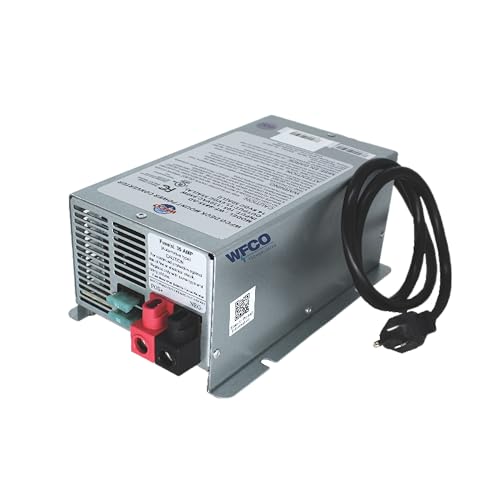
WFCO WF-9855-AD-CB 55A Converter/Charger
$248.99Genuine WFCO auto-detect unit for a rig already built around a WFCO power center slot.
Best for: A direct drop-in replacement in a WFCO power center.
Check price on Amazon
PowerMax PM4-55A 55A Converter, Lithium
$143.00Same 55A lithium-capable class with selectable output voltage for matching a specific battery spec.
Best for: A build where the charge voltage has to be set exactly.
Check price on Amazon
VEVOR 55A RV Converter with 4-Stage Charging
$64.84Four-stage charging at under half the PowerMax price, with less published lithium profile documentation.
Best for: A budget converter replacement.
Check price on AmazonFrequently asked questions
- Why will my stock RV converter not fully charge a lithium battery?
- A stock converter built for lead-acid applies an absorption voltage lower than what LiFePO4 needs to reach a true full charge, so the battery appears to charge but plateaus below 100 percent every time. This is one of the most commonly overlooked steps in a lithium battery conversion.
- Is the PowerMax PM3-55LK a drop-in replacement for any converter?
- Not universally. It is a deck-mount unit, so confirm the existing power center has the physical mounting space and compatible wiring before ordering, since not every factory converter slot is built for a deck-mount replacement of this exact size.
- Do I need to change my solar controller too if I install this converter?
- Yes, if the bank is lithium. This converter only handles shore power and generator charging. A solar charge controller running a lead-acid profile will undercharge the same lithium bank independently of what the converter does correctly, so it needs its own genuine lithium setting.
- What amperage does the PM3-55LK charge at?
- It is rated at 55A, according to the manufacturer's published specifications, which covers a typical single to double battery lithium bank on shore power or generator charging. Confirm that rating comfortably covers the battery bank's recommended charge current before assuming a faster recharge time than the converter can actually deliver.
- Should I buy this converter if I am staying on lead-acid?
- No. A lithium-specific converter brings no benefit to a lead-acid or AGM battery. If the existing stock converter already charges lead-acid correctly, there is no reason to replace it with a lithium-profile unit, and doing so would spend money on a charge profile the battery cannot use.
- What is the difference between the PM3-55LK and the PM4-55A?
- Both are 55A deck-mount converters with a lithium profile from PowerMax. The PM4-55A adds selectable output voltage, letting an owner match a specific manufacturer-recommended charge voltage more precisely, where the PM3-55LK runs a dedicated lithium mode without that same selectable range.
Researched from published specifications and verified owner reviews, not in-person testing. Confirm the converter, the solar charge controller and any DC-DC charger all carry a genuine lithium profile before considering a conversion complete.