Solar
Best Portable Solar Panels for RV Boondocking in 2026
Researched from published standards and manufacturer specifications. Updated .
Quick answer
The Renogy 200W Portable Solar Suitcase is the best portable solar option for RV camping, folding out to 200 watts with a built-in waterproof 20A charge controller and an adjustable kickstand, so it can be aimed at the sun while the rig itself stays parked in shade. Budget campers can get the same 200 watts from the DOKIO 200W Foldable Solar Suitcase instead, for roughly a third of the price.
A portable panel solves a problem a rooftop array cannot: it can be carried into open sun and repositioned through the day, while the RV itself stays parked under shade trees. That flexibility matters most for campers who deliberately choose shaded sites, since a fixed rooftop array in that same spot would produce very little power for the whole stay.
Most portable panels in this category fold into a suitcase-style case with an integrated kickstand and a built-in charge controller, which means no separate controller purchase or roof wiring is required. The trade-offs between models here come down to whether the built-in controller is waterproof, how much the panel weighs to carry and set up each morning, and whether you are paying for durability and features you will actually use versus a simpler folding panel at a lower price.
How we chose these portable RV solar panels
We did not test any of these panels in person. Rankings come from published wattage and controller amperage specifications on each listing, along with verified owner reviews describing real-world durability of the folding hinges and case after repeated setup and breakdown, since that is the failure point portable panels experience that rooftop panels do not.
Portable vs rooftop: when does carrying a panel make more sense?
A portable panel earns its place specifically when you park somewhere a rooftop array would perform poorly, most often a shaded campsite, and you are willing to set the panel up and take it down each day. If you typically camp in open, sunny sites and want power without any daily setup, a rooftop array is the better fit. Many boondockers run both: a rooftop array for baseline charging and a portable panel as a supplement on shaded stays. Our rooftop vs portable solar comparison walks through that decision in more detail.
Portable solar panels compared
All four panels here are rated at 200 watts. The meaningful differences are whether a charge controller is built into the case and how the panel folds for transport.
| Panel | Built-in controller | Foldable case | Price |
|---|---|---|---|
| Renogy 200W Suitcase | 20A, waterproof | Yes | $322.99 |
| ACOPOWER 200W Suitcase | 20A, waterproof | Yes | $278.50 |
| BougeRV 200W Foldable | Not included | Yes, fiberglass-backed | $199.99 |
| DOKIO 200W Suitcase | Included | Yes | $109.99 |
Published standard Source: Manufacturer spec sheets on the product listings, current at time of writing..
Getting the best angle from a portable panel
A panel aimed directly at the sun, perpendicular to its rays, produces more power than the same panel left flat on the ground, which is the entire advantage a portable panel has over a fixed rooftop array. Most suitcase-style panels include an adjustable kickstand or leg specifically for this reason, and re-angling the panel every hour or two as the sun moves across the sky captures noticeably more output over a full day than setting it once in the morning and leaving it. On a foldable panel without a built-in stand, like the BougeRV, a simple prop or strap can achieve the same angling with a bit more manual adjustment.
Storing and transporting a portable panel between trips
A folding panel spends most of its life packed away rather than deployed, so how it survives storage and transport matters as much as its rated output. Cases with reinforced corners and a carrying handle hold up better to being tossed into a basement storage bay repeatedly than a bare panel with exposed edges, and keeping the panel dry before folding it away prevents moisture from being trapped against the cells during transport. Coiling and securing the connecting cable separately, rather than leaving it loose in the case, avoids wear at the connector over repeated trips, which is one of the more common points of failure verified owner reviews mention for this category.
A controller in the case vs a folding panel with none
The BougeRV panel is a fiberglass-backed folding panel without a built-in controller, which makes it noticeably lighter to carry and set up than a framed suitcase, at the cost of needing a separate charge controller between the panel and the battery. If low weight for daily carrying matters more to you than an all-in-one package, that trade-off can be worth it, provided you already have or budget for a compatible controller.

BougeRV 200W Foldable Solar Panel
$199.99A fiberglass-backed folding panel is considerably lighter to carry and set up than a framed suitcase.
Best for: Anyone who will actually carry the panel out each morning.
Check price on AmazonHow much cable do you need to reach the battery?
A portable panel set up in open sun away from the rig needs enough cable length to reach the battery compartment without running through a door or window left ajar, which is a common weak point for both security and weather sealing. Size that cable run's gauge for the panel's rated current using a wire gauge calculator, and check the run against a wire gauge ampacity chart if you plan to extend the factory leads with additional cable.
Aimable output vs a fixed roof array, by site condition
The advantage of a portable panel is entirely about what happens when the RV itself is parked somewhere the sun does not reach. This is a qualitative comparison of the two approaches under different site conditions, not a measured output figure.
| Site condition | Fixed rooftop array | Portable panel moved into sun |
|---|---|---|
| Fully open, sunny site | Full rated output | Full rated output, extra setup effort for no real gain |
| Partial shade on the RV | Reduced output | Can be relocated to remaining open sun |
| RV fully shaded, open ground nearby | Little to no output | Can reach full rated output if repositioned |
Convention Source: General solar siting principles: unshaded, sun-facing placement produces the panel's full rated output, while shading reduces it.. Descriptive comparison, not a measured output test of any specific panel.
What a portable panel will not do
A single 200W portable panel will not replace a full rooftop array as the primary charging source for a rig running a residential fridge and heavy inverter loads continuously, and it requires someone to physically set it up, aim it, and pack it away each day rather than working unattended the way a rooftop array does. It is also not weatherproof to the same standard as a permanently bolted rooftop panel in every case, so leaving one out overnight in unexpected rain is a real risk depending on the specific model's rating. Portable solar is best treated as a supplement for shaded campsites or as a secondary source alongside a rooftop array, not as a full replacement for one.
Confirm the built-in controller's charge profile matches your battery chemistry. A portable panel's integrated controller may default to a lead-acid charge curve. If you are charging a LiFePO4 bank, check the panel's documentation for a lithium setting before relying on it as your primary charge source.
The best portable RV solar panels by tier
Do not pay the expert-tier premium if you only plan to use a portable panel a handful of times a season. The core function, folding out flat and charging through a built-in controller, is shared across all four of these panels, and the extra cost mainly buys a sturdier kickstand and a more weatherproofed case.

DOKIO 200W Foldable Solar Suitcase
$109.99The lowest-cost way to add 200 watts of aimable solar, with a controller already included in the package.
Best for: Occasional boondocking on a budget.
Check price on Amazon
ACOPOWER 200W Portable Solar Kit
$278.50Includes a waterproof 20A controller in the case, so it can charge a bank directly without adding anything to the roof or the battery compartment.
Best for: Adding capacity without drilling.
Check price on Amazon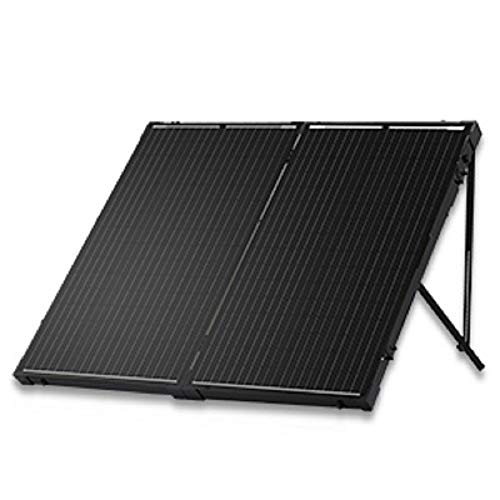
Renogy 200W Portable Solar Suitcase
$322.99Adjustable kickstand and a waterproof controller from the brand with the most documented compatibility with other RV solar components.
Best for: Campers who park under trees on purpose.
Check price on AmazonFrequently asked questions
- Can a portable solar panel charge a lithium battery directly?
- It can, as long as the panel's built-in controller, or a separate controller you add, has a genuine LiFePO4 charge profile rather than only a lead-acid one. Check the specific panel's documentation for a lithium setting before assuming it will properly charge a lithium bank to full.
- How far can I run cable from a portable panel to my battery?
- Longer cable runs need a heavier gauge wire to avoid excessive voltage drop, which reduces charging efficiency the farther the panel sits from the battery. Use a wire gauge calculator with your specific cable length and the panel's rated current to choose the correct gauge rather than reusing whatever cable happens to be on hand.
- Do I still need a charge controller if the portable kit does not include one?
- Yes. A solar panel connected directly to a battery with no controller can overcharge the battery, since the panel has no way to reduce or stop current once the battery reaches full charge. Any panel without a built-in controller, like the BougeRV folding panel, needs a separate PWM or MPPT controller wired between the panel and the battery.
- Are foldable panels durable enough for regular use?
- Foldable panels are built for repeated setup and breakdown, but the folding hinges and case zippers are the parts most likely to wear over time with frequent use. Verified owner reviews are the best guide here, since manufacturer specifications rarely quantify hinge cycle life the way they quantify electrical output.
- Can I use a portable panel and a rooftop array at the same time?
- Yes, provided each has its own controller, or you use a controller designed to accept multiple independent panel inputs. Running both simultaneously is a common setup for boondockers who want a rooftop baseline plus extra portable capacity on shaded stays or overcast days.
- How much does a 200 watt portable panel weigh?
- Weight is not consistently published across every listing in this category, and it varies meaningfully between a framed suitcase design and a fiberglass-backed folding panel, with the fiberglass-backed style generally weighing less. Check the specific listing's published weight rather than assuming all 200W portable panels weigh the same amount.
Check the built-in controller's charge profile against your battery chemistry before your first trip. A portable panel is only as useful as the controller feeding it, and a lead-acid-only profile on a lithium bank will leave your battery undercharged no matter how much sun the panel sees.