Guides
How to Size an RV Battery Bank: From Daily Amp-Hours to a Real Number
Researched from published standards and manufacturer specifications. Updated .
Quick answer
Sizing a house battery bank is genuinely simple arithmetic once you have one number: how many amp-hours the rig uses in a typical day off grid, covered in full in the boondocking energy budget guide linked below. Everything past that number, choosing days of autonomy, applying a depth of discharge convention, and checking the result against a real battery's BMS rating and case size, is a short, mechanical process rather than a guess.
This guide walks through that process end to end: the formula, the depth of discharge conventions for lead-acid and LiFePO4, why the battery's BMS continuous amp rating matters as much as its amp-hour rating, and the physical fit checks that a pure amp-hour calculation skips entirely. The battery bank calculator on this site runs the same formula directly.
What is the formula for sizing a battery bank?
Nominal amp-hours needed equals daily amp-hour usage multiplied by the number of days you want to run without recharging, divided by the depth of discharge convention for your battery chemistry. A rig using 60 amp-hours a day, planning for three days off grid, on a lithium bank at an 80 percent usable depth, needs (60 times 3) divided by 0.8, or 225 amp-hours nominal. The same daily usage and days on a lead-acid bank at a 50 percent usable depth needs (60 times 3) divided by 0.5, or 360 amp-hours nominal, showing directly why a lithium bank can be smaller and lighter for the same usable capacity. The battery bank calculator on this site runs this exact formula and also reports the usable amp-hours and usable watt-hours the resulting bank actually delivers.
Why is depth of discharge a convention and not a spec?
No battery manufacturer publishes a single usable depth of discharge number on a spec sheet, because cycle life actually falls along a curve against how deep each cycle goes, not a fixed cutoff. The figures below are the widely used planning conventions for each chemistry, not a manufacturer specification, and they intentionally leave some reserve rather than running a battery to its absolute rated limit on every cycle.
| Chemistry | Usable depth of discharge (convention) | Why |
|---|---|---|
| Lead-acid (AGM, flooded, gel) | ~50% | Cycle life falls off sharply past this point on most published discharge curves. |
| LiFePO4 | ~80% | Many packs are rated to 100% depth, but planning at 80% leaves reserve and is the more conservative figure. |
Convention Source: Widely repeated planning guidelines for lead-acid and LiFePO4 usable depth of discharge, not a single manufacturer specification.. Check your specific battery's cycle life versus depth of discharge curve if the manufacturer publishes one, and use it in place of the general convention when available.
Why does the BMS continuous amp rating matter as much as the amp-hour number?
An amp-hour rating describes how much energy a battery holds, not how fast it can safely deliver that energy, and those are two different questions. A battery's built-in BMS carries its own continuous amp rating, and drawing more than that, even briefly under a heavy load, can trip the BMS and cut the battery off entirely rather than simply running it down faster. A 2000W inverter running near full load on a 12V system can pull close to 200 amps from the bank, so a single 100Ah battery with only a 100A BMS rating is a mismatch for that inverter even though the amp-hour capacity might otherwise look adequate on paper. Check the BMS continuous rating on the specific battery's spec sheet against the largest single draw your system will ever ask of it, not just against the average daily load calculated earlier in this guide.
What if one battery's BMS rating is not enough?
Wiring two or more batteries in parallel does not just add their amp-hour capacity together, it also adds their BMS continuous ratings together, which is often the real reason a build goes to two smaller batteries instead of one larger one. Two 100Ah batteries each rated for 100A continuous, wired in parallel, together support a 200A draw that a single 100Ah battery with a 100A BMS could not. This is worth checking before assuming a single large-capacity battery automatically covers a heavy inverter load; the amp-hour total on the label says nothing about the current rating underneath it.
How does the physical size of the battery matter once the math checks out?
A battery bank calculation has no idea what will physically fit in your battery bay, and that gap between the arithmetic and the compartment is a common late-stage surprise. LiFePO4 batteries in common Group 24, Group 27 and Group 31 case sizes cover most factory battery compartments, but a bay built for one battery at Group 24 will not accept a battery built to Group 31 dimensions without modification. Weight matters separately from case size: even at LiFePO4's lower weight per amp-hour, a multi-battery bank adds real payload, which matters on a trailer already close to its cargo carrying capacity. Measure the actual bay before ordering a battery, and check the specific product's listed dimensions and weight rather than assuming a BCI group label guarantees a fit, since case dimensions vary slightly between manufacturers even within the same nominal group.
How do you check your work before buying anything?
Run the sizing formula with your own measured daily amp-hours, not a borrowed number, then confirm three things about the specific battery you are considering: the BMS continuous rating against your largest expected draw, the case dimensions against your measured bay, and the charge profile compatibility with your converter, solar controller and any DC-DC charger if the bank is lithium. A battery that passes the amp-hour math but fails any one of those three checks is the wrong battery for the build, regardless of how attractive its price or capacity looks on its own.
How many days of autonomy should you actually plan for?
Most boondocking builds plan around two to four days of autonomy, though the right number depends on how often you can realistically get to a fresh charge, from driving, sunlight, or a generator, not on an arbitrary standard everyone should use. A rig that mostly boondocks somewhere sunny enough for solar to fully recover the bank most days can plan a shorter autonomy window, since the battery rarely needs to bridge more than a cloudy day or two before topping back up. A rig that dry camps in heavy tree cover, in a region with limited sun for part of the year, or without a generator as backup, does better planning for a longer window, since there is no guarantee of a full recharge on any given day. Carrying a generator as backup changes the math again: a bank sized for two days plus a generator that can bring it back to a workable charge in an evening is a very different plan than the same two-day bank with no backup charging source at all. Oversizing autonomy past what your actual charging pattern supports mostly buys unused capacity and unnecessary weight, since a bank that rarely gets a chance to fully discharge before the next recharge opportunity does not benefit much from the extra days built into its original sizing. The honest way to pick a number is to look back at your last several boondocking trips, or a planned itinerary if this is a new build, count the longest realistic stretch between charging opportunities, and size to that stretch rather than to a number chosen because it sounded appropriately cautious.
Never mix battery chemistries or ages in the same bank. Parallel-wiring a new battery with an older one, or mixing lead-acid with lithium, can cause uneven charging and premature failure. Replace a bank as matched sets, not one battery at a time.
Which battery to buy once you have a target size
Pick the nominal amp-hour size from the formula below first, then choose a specific battery against three things: the BMS continuous amp rating against whatever inverter or high-draw load will pull from it, the physical case size against your battery bay, and whether the bay ever sees freezing temperatures, which points toward a self-heating pack instead of a standard one.
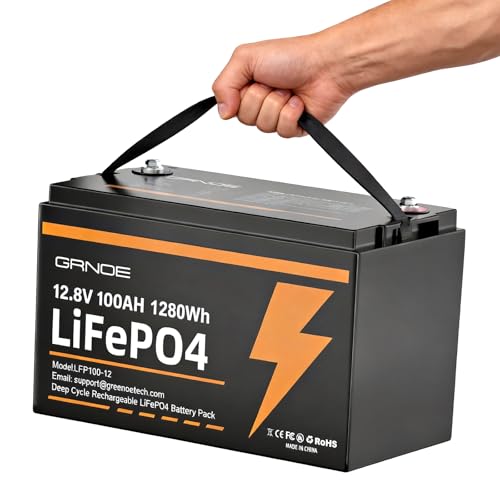
GRNOE 12V 100Ah LiFePO4, Group 31
$159.00A published 100A BMS in a Group 31 case, sized for a single-battery replacement on a budget.
Best for: Budget-led single battery replacement.
Check price on Amazon
Super Empower 12V 100Ah LiFePO4, Group 24
$182.99A smaller footprint for a battery bay that a Group 31 case will not physically fit into.
Best for: A first lithium conversion in a travel trailer that already has a Group 24 tray.
Check price on Amazon
Yeagulch 12V 200Ah LiFePO4
$316.59A 200A BMS rating covers the current a large inverter can actually pull under full load.
Best for: A single-battery bank that has to run a 2000W inverter.
Check price on Amazon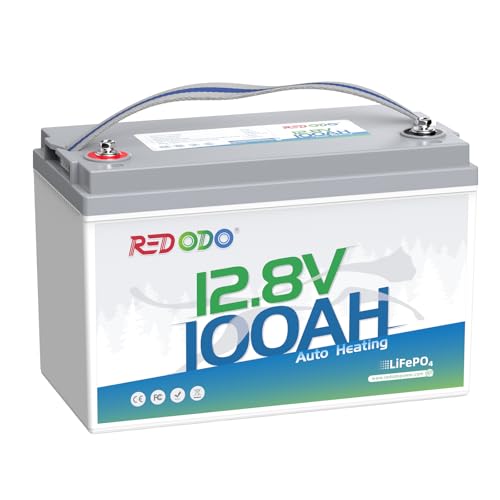
Redodo 12V 100Ah Self-Heating LiFePO4
$269.99Self-heating cells accept a charge below freezing, which a standard LiFePO4 cell cannot do safely.
Best for: A first cold-weather lithium battery.
Check price on AmazonFrequently asked questions
- How many amp-hours do I need for a weekend of boondocking?
- That depends entirely on your daily usage, not on a fixed weekend number. Calculate your daily amp-hour draw first using the boondocking energy budget guide, then multiply by the number of days and divide by your chemistry's depth of discharge convention. A rig using 50 amp-hours a day for a two-day weekend on lithium at 80 percent needs roughly 125 amp-hours nominal.
- Is a bigger amp-hour rating always better?
- Not if it comes at the cost of a lower BMS continuous rating, a case that does not fit your battery bay, or more weight than your payload allows. Size the amp-hours to your actual daily usage and days of autonomy first, then check the BMS rating and physical fit before treating a larger number as automatically better.
- Why do two 100Ah batteries in parallel handle more current than one 100Ah battery?
- Because parallel wiring adds each battery's BMS continuous amp rating together along with their amp-hour capacity. Two batteries each rated for 100A continuous support 200A combined, which a single 100Ah battery with only a 100A BMS cannot do alone, even though the total amp-hour capacity is identical in both cases.
- Do I need to size a lithium bank differently than a lead-acid bank?
- Yes, mainly through the depth of discharge convention: roughly 80 percent usable for LiFePO4 against roughly 50 percent for lead-acid, which means a lithium bank can be smaller and lighter for the same usable amp-hours. The BMS continuous rating check and physical fit check apply to both chemistries equally.
- What happens if I draw more current than a battery's BMS is rated for?
- Most BMS units respond by disconnecting the battery entirely rather than allowing damage, which shows up as the battery suddenly cutting out under a heavy load like an inverter surge. This is a protective response, but it means an undersized BMS rating causes real, repeatable outages under specific loads rather than a gradual performance drop.
- Should I check my battery bay size before or after choosing an amp-hour target?
- Calculate the amp-hour target first from your daily usage, since that number decides roughly how much capacity you need regardless of case size. Then check specific battery options against your measured bay dimensions and weight budget, since more than one case size and chemistry combination can often reach the same target capacity.
Size the amp-hours first, then check the battery against reality. A number from the formula above is only half the job. Confirm the BMS continuous rating against your heaviest load and the case dimensions against your actual battery bay before buying.