Guides
RV Shore Power Guide: Using 30 Amp and 50 Amp Service Safely
Researched from published standards and manufacturer specifications. Updated .
Quick answer
Shore power looks simple: find the right plug, connect, done. The parts that actually protect your rig happen before and after that connection, checking what the pedestal can really deliver, and knowing what your own service size can and cannot run at once.
This guide covers the real math behind 30A and 50A service, what an adapter does and does not do, how to size loads to your service, and why testing the pedestal matters as much as picking the right plug.
How much power does a 30A versus a 50A service actually give me?
A 30A RV service is a single 120V leg, so total available power is 120 volts times 30 amps, or 3,600 watts. A 50A RV service is two separate 120V legs, each rated 50 amps, so total available power is 120 volts times 50 amps times two legs, or 12,000 watts. That is more than three times the power of 30A service, not the 67 percent increase the raw amperage numbers alone would suggest, because the second leg is the part that changes the math, not just a bigger number on the same single leg.
What can I actually run on each service size?
Run watts and startup watts below are drawn from this site's published appliance draw reference, useful for a quick sanity check against the totals above.
| Appliance | Run watts | Startup watts |
|---|---|---|
| RV air conditioner, 13,500 BTU | 1,400W | 3,000W |
| RV air conditioner, 15,000 BTU | 1,700W | 3,500W |
| Electric water heater element | 1,440W | 1,440W |
| Microwave, 1000W output | 1,500W | 1,500W |
| Space heater, high setting | 1,500W | 1,500W |
Published standard Source: Published typical appliance draw figures, this site's appliance draw reference.. One air conditioner's startup surge alone can use most of a 30A service's 3,600 watt total; a 50A service splits its 12,000 watts across two legs, typically around 6,000 watts of headroom per leg.
What does an adapter actually do?
A dogbone adapter changes which plug shape fits the pedestal receptacle. It does not change the amperage actually available to the rig. A 30A rig plugged into a 50A pedestal through an adapter is still limited to 30A total, because the rig's own cord, breaker and wiring are rated for 30A no matter what the pedestal can supply. A 50A rig plugged into a 30A pedestal through the reverse adapter is limited to 30A total, roughly a quarter of its normal capacity, for as long as it stays on that connection, so load management matters far more in that direction.
How do I tell which shore power service my rig has?
Look at the plug on the shore power cord itself. A 30A plug has three prongs; a 50A plug has four prongs and is visibly larger. Do not assume service size from the rig's overall length or class, since some mid-size rigs carry 50A service despite a similar footprint to a 30A trailer. The main breaker panel inside the rig is also labeled for the service size and is worth checking if the cord end is ever unclear.
Why should I test a pedestal before plugging in?
A campground pedestal's receptacle rating does not guarantee it is actually delivering that voltage and amperage, particularly at older or busier parks during peak demand when many rigs draw at once. Low voltage under load can damage a compressor in a refrigerator or air conditioner just as surely as a voltage spike can damage electronics, and a sagging pedestal often shows no visible sign of the problem from the plug end. An EMS checks delivered voltage automatically before allowing the connection through, which is the practical reason to run one regardless of how well-maintained a park looks.
What does an EMS protect against that a basic surge protector does not?
A basic surge protector only clamps a voltage spike. An EMS additionally disconnects the rig on low voltage, high voltage, open ground and reverse polarity, all of which show up at campground pedestals without ever producing a spike. On a 50A service specifically, the EMS needs to monitor both hot legs independently, since a fault confined to one leg can exist without affecting the other, and a single-leg monitor on a 50A connection would simply miss it.

Progressive Industries EMS-PT50X, 50A
$187.15A 50A service is two 120V legs, and an EMS watches both. A fault on one leg is invisible if you only monitor the other.
Best for: Any 50A rig.
Check price on AmazonDoes 50A service charge my battery faster than 30A?
No. Charging speed is set by the converter or inverter/charger's own rated output current, not by the shore power service size. Both 30A and 50A service can fully power a given converter's charging circuit; the difference between the two services is total available power for running appliances and air conditioners at the same time, not how quickly the house battery refills.
What should I check before I leave a rig plugged in unattended?
Confirm the EMS or surge protector is actually connected and showing a normal status light before walking away, since a bypassed or unplugged protector defeats the purpose entirely. Check that any adapter in use is the correct direction for the pedestal and rig combination, and recheck the load total against the service's real wattage ceiling if you have added a new high-draw appliance since the last time you camped there.
Can I run my RV on a household 15A or 20A outlet instead of a pedestal?
Yes, with a household plug adapter, but the available power drops sharply. A standard 15A household outlet delivers about 1,800 watts, and a 20A household outlet delivers about 2,400 watts, both well under a 30A RV service's 3,600 watts. Running an air conditioner off a household outlet through an adapter is usually not realistic once its startup surge is counted, and running anything beyond basic lights, charging and a small appliance at a time risks tripping the household circuit's own breaker, which is sized for general household use, not for an RV's full load.
What is the risk of daisy-chaining extension cords to reach a pedestal?
Every extension cord in a chain adds resistance, and resistance under load produces voltage drop and heat at each connection point, which is worse with undersized cords and worse still with multiple connections in series. A long single run of a properly rated RV-grade shore power cord is safer than several shorter household extension cords joined together, both because the RV cord is rated for the full amperage and because fewer connection points means fewer places for a loose or corroded plug to overheat.
Does the condition of the pedestal receptacle itself matter beyond amperage?
Yes. A worn or loose receptacle can deliver correct voltage on a meter check while still making poor contact under the higher current an air conditioner or a full house load draws, which can show up as intermittent power or a receptacle that runs unusually warm to the touch after use. A receptacle that feels loose when the plug is inserted, or one with visible scorching or discoloration, is worth avoiding or reporting rather than using, regardless of what an EMS reads at idle before a heavy load is applied.
What goes wrong with shore power, and how do you catch it before it damages something?
The most common failure is treating a pedestal's rated amperage as a guarantee of actual delivered voltage, then running a compressor-based appliance on a pedestal that is quietly sagging under load at a busy park. The second is expecting a dogbone adapter to raise available power in the wrong direction, plugging a 50A rig into a 30A pedestal and then running loads sized for the full 50A service. The third is leaving a surge protector connected but never checking that it is actually functioning, since a protector that has already sacrificed itself to a past surge event can sit connected while doing nothing on a later one. An EMS that actively disconnects on a fault, rather than a passive protector that only clamps a spike, catches the first two; checking the device's status indicator catches the third.
What actually fits on 30A versus 50A at the same time?
| Load combination | Fits on 30A (3,600W)? | Fits on 50A (12,000W, ~6,000W per leg)? |
|---|---|---|
| One 13,500 BTU AC plus lights and charging | Tight, little headroom left | Yes, comfortably |
| Two 13,500 BTU AC units running together | No, exceeds 3,600W with startup surge | Yes, typically split across the two legs |
| AC plus microwave plus electric water heater | No | Usually, if spread across both legs |
| AC plus residential washer/dryer combo | No | Often requires careful leg balancing |
Published standard Source: Totals from NEMA TT-30 and NEMA 14-50 device ratings; individual appliance watts from this site's published appliance draw reference.. Actual fit depends on which circuits are wired to which leg on a 50A service and on each appliance's specific startup surge, not just its running watts.
Never assume a pedestal is delivering its rated voltage. Test with an EMS before connecting, or connect through one permanently. Low voltage under load can damage a compressor just as effectively as a surge, and it often gives no warning before the damage is done.
What to buy for shore power
Buy the EMS that matches your rig's actual service size, not the pedestal you happen to be plugged into. Buy a dogbone adapter only to change which plug shape fits, and never expect it to raise the amperage available to a rig with a smaller service rating than the pedestal.

Progressive Industries EMS-PT30X, 30A
$135.89Disconnects on low voltage, high voltage, open ground and reverse polarity on a single 120V leg.
Best for: Anyone plugging into parks they have not vetted.
Check price on Amazon Progressive Industries EMS-PT50X, 50A
$187.15Independently monitors both 120V legs of a 50A service for the same fault conditions.
Best for: Any 50A rig.
Check price on Amazon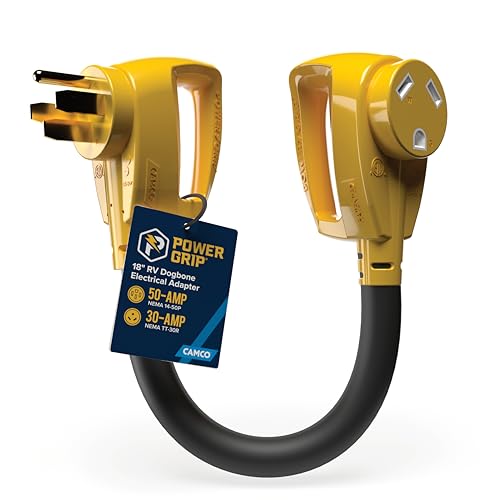
Camco PowerGrip Dogbone, 50A Male to 30A Female
$16.11Lets a 30A rig plug into a 50A pedestal without changing the rig's own 30A, 3,600 watt limit.
Best for: A 30A rig at a 50A pedestal.
Check price on Amazon
Surge Guard 40100 50A Automatic Transfer Switch
$181.49Permanently wired protection for a rig that stays connected to shore power for extended stretches.
Best for: Protecting compressors during changeover.
Check price on AmazonFrequently asked questions
- Is 50A shore power really more than three times the power of 30A?
- Yes. A 30A service is one 120V leg at 3,600 watts total. A 50A service is two separate 120V legs at 50A each, for 12,000 watts total. That works out to more than three times the power, even though the amperage figures alone, 30 versus 50, only differ by 67 percent.
- Can a 50A rig run at full power through a dogbone adapter into a 30A pedestal?
- No. The adapter only changes the plug shape. The pedestal itself is still wired for 30A, so a 50A rig connected through this adapter is limited to 30A total, roughly a quarter of its normal 12,000 watt capacity, for as long as it stays connected there.
- Do I need an EMS if the campground looks well maintained?
- Yes. Pedestal condition is not reliably visible from the outside, and low voltage or wiring faults can exist even at newer-looking parks, especially during peak demand when many rigs draw power at once. An EMS checks the actual delivered voltage before allowing the connection through, regardless of how the pedestal looks.
- Can I run two air conditioners on a 30A shore power connection?
- Generally not at the same time. Two air conditioners together typically exceed the 3,600 watts available on a 30A service once startup surge is included, which is one reason larger rigs with dual AC units are built around 50A service instead.
- Why does a 50A EMS need to monitor two legs separately?
- Because 50A service is two independent 120V legs, and a fault, dropped leg, or reversed polarity on one leg can exist without affecting the other. A single-leg monitor connected to a 50A service would miss any problem confined to the leg it is not watching.
- Does shore power service size affect how fast my battery charges?
- No. Charging speed depends on the converter or inverter/charger's own rated output current, not on whether the pedestal is 30A or 50A. Service size determines how much total power is available for running appliances at once, separate from battery charging speed.
- Can I run a residential air conditioner and a microwave at the same time on 30A?
- Usually not. A single air conditioner's running and startup watts already use a large share of a 30A service's 3,600 watt total, and adding a microwave's roughly 1,500 watts on top of that typically exceeds what the service can supply, tripping the pedestal breaker or the rig's own main breaker.
- Is it safe to plug an RV into a regular household extension cord in a pinch?
- Only briefly, for light loads, and only with a cord rated for the current involved. A household extension cord is typically rated well under an RV's 30A or 50A service, and running it at or near that rated current for an extended period risks the cord overheating. An RV-grade shore power cord, run in one length without added extension cords, is the safer option for anything beyond a short, light-load exception.
A word on safety. Test or protect every shore power connection with an EMS before relying on it, since a pedestal's rated amperage does not guarantee it is delivering safe voltage. Never assume an adapter increases the power available to your rig; the lower-rated side of any adapter sets the real limit.