Guides
How to Test and Safely Connect to a Campground Pedestal
Researched from published standards and manufacturer specifications. Updated .
Quick answer
Test a pedestal before connecting, or let a plug-in EMS do it automatically. The faults that damage an RV are open ground, reverse polarity, high voltage, and low voltage, which is common at a busy park on a hot afternoon and destroys a compressor as surely as a surge does. Turn the pedestal breaker off before plugging in or unplugging, plug in the EMS, then turn the breaker back on. A plain surge protector does not disconnect on low voltage; an EMS does.
A campground pedestal is wired and maintained by whoever owns the park, and that ranges from a well-inspected resort to a decades-old box with a receptacle that has been swapped a dozen times by different maintenance crews. Nothing about how an RV plug looks or feels tells you whether the wiring behind it is correct, which is why testing the connection, not just making it, is the actual safety step.
This guide covers the specific faults a pedestal can have, the difference between a device that only clamps a spike and one that also disconnects on a bad condition, and the order of operations that keeps you from making or breaking a connection under load. None of this replaces reading your specific EMS or surge protector's manual, but it explains what the fault categories actually mean before you are standing at a pedestal deciding whether to trust it.
What actually goes wrong at a campground pedestal?
Four faults account for most of the damage an RV suffers from shore power, and a receptacle can look completely normal while any of them is present. Open ground means the safety ground path back to the source is missing or broken, so a fault inside the RV that should trip a breaker instead energizes the RV's metal chassis. Reverse polarity means the hot and neutral conductors are swapped inside the pedestal wiring, which can leave exposed metal live even when an appliance is switched off. High voltage happens when a pedestal is fed above its rated voltage, most often from an overloaded transformer or a wiring error upstream of the receptacle. None of these four require the pedestal to look damaged, cracked, or old. A brand new pedestal, wired wrong once during installation, carries the same fault every time anyone plugs in.
Why does low voltage matter more than a surge?
A surge is a brief spike, and it gets the most attention because the word sounds dramatic. Low voltage is quieter and more common, and it is the one that actually kills air conditioner and refrigerator compressors. When many rigs draw power from the same feed at a busy park on a hot afternoon, with every air conditioner running, the voltage delivered to each pedestal can sag well below normal. A compressor motor running on sagging voltage draws more current to do the same work, overheats, and fails, often without anything visibly wrong at the pedestal at the time. A plain surge protector only clamps a voltage spike; it does nothing when voltage sags low, which is exactly the condition an EMS is built to catch and disconnect from before damage happens.
What is the difference between a receptacle tester, a surge protector and an EMS?
These three devices are often confused because a first-time buyer assumes any plug-in box at the pedestal does the same job. They do not.
| Device | Detects wiring faults | Clamps a voltage spike | Disconnects on low or high voltage |
|---|---|---|---|
| 3-light receptacle tester | Yes, manually, one-time check | No | No |
| Plug-in surge protector | Some models, indicator lights only | Yes | No |
| Plug-in or hardwired EMS | Yes, continuously while connected | Yes | Yes, automatically |
Published standard Source: Device functions as documented by manufacturers in the receptacle tester, surge protector and EMS categories on the product listings.. A receptacle tester is a useful one-time check of a suspect outlet, but it does not stay connected and cannot react to a fault that develops after you plug in.
What order should I connect and disconnect in?
Turn the pedestal's circuit breaker off before you plug your shore power cord or your EMS into the receptacle. Plug the EMS in first, then plug your RV's cord into the EMS. Only after both connections are made, turn the pedestal breaker back on and let the EMS run its check before it passes power through. When you are ready to leave, reverse the order: turn the pedestal breaker off first, then disconnect. Connecting or disconnecting a cord while the circuit is energized risks arcing at the plug contacts, which pits and eventually damages both the cord and the receptacle, and it is also simply unsafe to handle a live plug with wet hands or on wet ground, which describes a lot of camping mornings.
Does an adapter fix a bad pedestal or increase available power?
Neither. An adapter, sometimes called a dogbone, changes which plug shape fits a given receptacle. It does not add amperage, and it does not fix a wiring fault upstream of it. A 30A rig adapted into a 50A pedestal is still limited to 30A, and a 50A rig adapted down to a 30A pedestal is limited to 30A rather than its normal 50A per leg. If the pedestal itself has open ground or reverse polarity, an adapter carries that fault straight through to your EMS or your rig exactly as it was at the receptacle. Our 30A vs 50A shore power comparison covers why the two services are not simply scaled versions of each other.
Which fault should worry you most on a hot, crowded weekend?
Low voltage, specifically. Open ground and reverse polarity are wiring defects that exist or do not exist regardless of how many other rigs are plugged in nearby, and a decent tester or EMS catches them the moment you connect. Low voltage is different because it can appear only under load, meaning a pedestal that reads fine at ten in the morning can sag once every site around you has an air conditioner compressor cycling on a ninety-degree afternoon. That is precisely the condition where a plug-in EMS earns its price: it is watching continuously, not just at the moment you first plugged in, so a temporary sag mid-afternoon still gets caught and disconnected before your own compressors are damaged. Check your shore power budget against what the pedestal can realistically deliver under those conditions rather than assuming its rated amperage is always available. A busy holiday weekend at a popular park is the single most predictable time for this fault to appear, since it is exactly when every site is drawing the most current from a shared feed at once, so this is the condition worth being most prepared for rather than the exception.
What should I do if a pedestal fails the test?
Do not connect your rig to it. If your EMS refuses to pass power through, or a receptacle tester shows open ground or reverse polarity, the correct response is to report it to the campground office and either wait for the receptacle to be repaired or move to a different site with a working pedestal, not to work around the fault yourself. Some owners are tempted to bypass an EMS's disconnect because they are only staying one night and do not want the hassle of relocating, but that reasoning skips over the fact that the EMS disconnected specifically because the condition it detected was unsafe to connect to, regardless of how long you plan to stay. An open ground defeats your RV's entire safety ground path, and reverse polarity can leave exposed metal energized, and neither improves by ignoring the warning. If no other site is available, running on battery and generator power for the night is a better outcome than connecting to a pedestal your own equipment has already flagged as unsafe. Keep a note of which sites or parks have shown recurring pedestal faults, since a receptacle that fails once without maintenance in between is likely to fail the same way again on a future visit.
Never skip the breaker-off step. Turn the pedestal's breaker off before plugging in or unplugging, and let an EMS complete its check before it passes power through. A surge protector that only clamps spikes will not catch a low-voltage fault, an open ground, or reverse polarity, all of which an EMS is built specifically to disconnect on.
Which pedestal protection to buy
Match the unit to your rig's actual service size, not to whichever one is cheaper. A 30A EMS on a 50A rig, or the reverse through an adapter, only protects the leg it is wired to check, and a 50A rig run through a 30A-rated protector is not getting the two-leg monitoring a split-phase service needs.

Progressive Industries EMS-PT30X, 30A
$135.89The same disconnect protections as the 50A unit, sized for a single 120V, 30A leg, at a lower entry price.
Best for: Anyone plugging into parks they have not vetted.
Check price on Amazon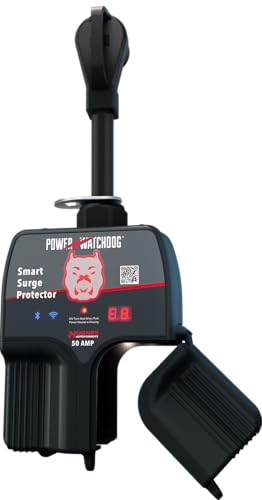
Power Watchdog PWD50W Smart, 50A
$249.99Reports voltage and current on each leg separately to a phone, which is how you catch a sagging pedestal before it reaches your rig's wiring.
Best for: Diagnosing which leg is carrying the air conditioners.
Check price on Amazon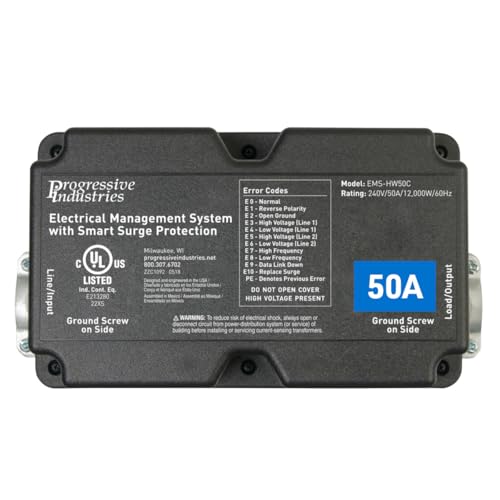
Progressive Industries EMS-HW50C Hardwired, 50A
$169.99A hardwired unit lives behind your own panel instead of sitting on the pedestal, which removes the most common failure mode of a portable EMS: someone walking off with it.
Best for: A permanent installation inside the rig.
Check price on AmazonFrequently asked questions
- Is a surge protector the same thing as an EMS?
- No. A surge protector clamps a voltage spike and stops there. An EMS, short for energy management system, additionally monitors for open ground, reverse polarity, high voltage and low voltage, and it disconnects the RV automatically when any of those conditions occurs. If a listing only mentions surge protection, assume it does not catch the low-voltage faults that damage compressors.
- Can I just use a cheap outlet tester instead of an EMS?
- A receptacle tester is useful for a one-time check of wiring at a suspect outlet, but it does not stay connected while you camp, so it cannot catch a voltage sag that develops later in the day under load. An EMS monitors continuously for as long as it is plugged in, which is the protection a receptacle tester cannot provide.
- Why does low voltage damage a compressor when a surge does not always?
- A compressor motor running on low voltage draws more current to produce the same mechanical work, which overheats the motor windings over time. A brief surge that gets clamped by a protector never reaches the appliance at all. Low voltage is more dangerous specifically because a plain surge protector has no way to detect or react to it.
- Does an adapter between a 30A and 50A plug increase available power?
- No. An adapter only changes the plug shape so it physically fits a different receptacle. The amperage available is always set by the smaller-rated side of the connection, so a 50A rig adapted down to a 30A pedestal is limited to 30A total for as long as it stays connected there, not its normal 50A per leg.
- Should I turn the pedestal breaker off before I unplug at the end of a stay?
- Yes. Disconnecting a cord while the circuit is still energized risks arcing at the plug contacts, which damages both the cord and the receptacle over repeated use. Turn the pedestal breaker off first, then disconnect your cord, the reverse of the order used when connecting.
- Will an EMS protect me from a pedestal that is simply overloaded by other campers?
- It will not increase the power available, but it will protect your RV from the low-voltage condition that overload creates. An EMS disconnects your rig when voltage sags below a safe threshold rather than letting undervoltage reach your appliances, which is the correct response to an overloaded feed you have no control over.
Test the pedestal every time, not just the first time. A receptacle that was fine last season can develop a fault, and a pedestal that reads fine in the morning can sag under afternoon load. An EMS that checks continuously, rather than a one-time tester, is what actually protects an RV parked at a park you do not control.